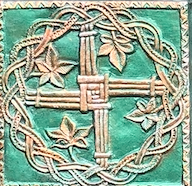
For many years now I have become increasingly reluctant to wear a cross necklace in public, not because I am ashamed of my Christian faith but because I’m afraid it will mark me as something I am not –- one of those people, as David Brooks put it, who “have crosses on their chest but Nietzsche in their heart—or, to be more precise, a high-school sophomore’s version of Nietzsche.”
Today, September 14th, the Catholic Church (along with Anglican and Eastern Orthodox Churches, I learned from Wikipedia) celebrates the Exaltation of the Holy Cross, a special feast day for my home parish of Holy Cross in Santa Cruz, California. My non-Christian friends may find it strange to exalt what they see as an instrument of torture and death, and I can’t blame them. In the Roman Empire crucifixion was a brutal method of execution meant to instill fear, and the cross was a symbol of their power. But for early Christians it came to represent the great love story that was the origin of the Church: the love of Jesus who laid down His life for his friends.
No one has greater love than this, to lay down one’s life for one’s friends. – Jesus (John 15:13)
To say that the cross symbolizes love might seem simplistic and vague, so I’m turning to Jesus’s own words for insight on how to be a little more specific. When I read the Gospel, it seems that for Jesus, love meant solidarity with the poor in spirit and pure of heart, with the meek and merciful, and with peacemakers (Matthew 5: 1-12). He asked his followers to feed the hungry, clothe the naked, and look after the sick, even to invite the stranger in and visit those in prison (Matthew 25: 34).
I confess to you, dear reader, that I am far from living up to this call, but that’s what I aspire to. If you notice the Brigid cross in my garden or see me wearing one around my neck, please know that it’s not a political statement. It simply means that I am choosing love over fear.
 The Kingdom of Enough