Ever since I was young, I have craved solitude. Growing up with two sisters and sharing a room with one of them, I inevitably tired of company and play and sought my own space, hiding out under the pine tree in our backyard or even in my bedroom closet. Eventually I learned the language to know myself: I’m an introvert. Not a misanthrope, which is how I might sometimes appear in a culture that prizes the extrovert ideal, but a person whose energy is drained by being with people even as much as I love them. Before the pandemic I sometimes thought of myself as a misplaced hermit; then, in those long months of isolation, I discovered how much I also thrive in community: the laughter and sharing at a convivial dinner party, gathering with my writing group, book club, sangha, church. Post-pandemic reunions brought profound joy, and I discovered a new pleasure: meeting a colleague or friend in person whom I’d only known on Zoom.
When I think about the job I retired from and what I miss most, two things come to mind. First, my colleagues and our students, the sense that we were engaged in a shared endeavor, that together we belonged to and made up Foothill College. But second is the pleasure of my usually solitary walk across campus early in the morning, letting myself into the silent, dimly lit library, the sanctuary of my office. At home, one of my favorite rituals with Tom is sharing our mochas in the morning — we sit together in a loveseat looking out at the garden, and he reads the news while I journal. Surprisingly, though, when he’s out of town and I have only my notebook for company, my morning mocha tastes just as good.
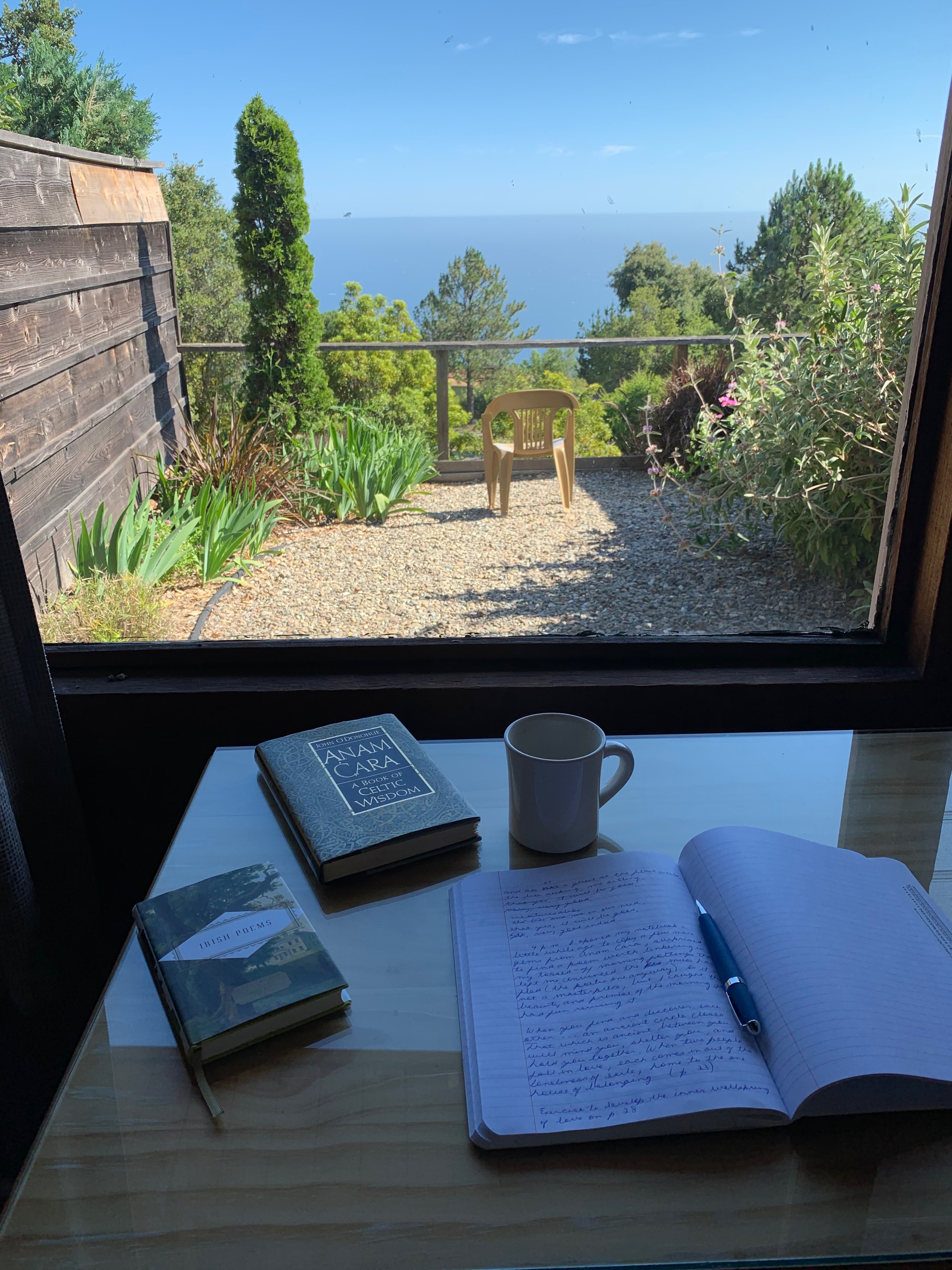
Solitude and community. Am I drawn by contradictory energies? Maybe not. One of my favorite places in the world is New Camaldoli Hermitage, a Benedictine community on a remote Big Sur mountaintop overlooking the wild Pacific. It pulls me with its incomparable beauty, a room of my own (or cell, to use the monastic term), and the chance to detach from the internet-connected world. Also vital, though, is the opportunity to pray with the monks each day and the presence of my fellow retreatants. Even though we don’t talk to each other, it’s comforting to know that they are there. We hold the kitchen door open for each other, smile at one another on the way to chapel. The monks manage to offer us gracious hospitality and the gift of silence. It’s built into their way of life, and they demonstrate that the question isn’t solitude or community; it’s both/and. Rather than contradicting, solitude and community feed each other.
If I were willing to stretch a metaphor, I’d say it’s like making a good mocha, perfectly blending the ingredients of coffee, chocolate, and milk, but you can’t really have solitude and community at the same time, can’t mix them together so they become an entirely new way of being. No, to balance these energies requires a daily braiding of together and alone. It’s more like my Breacadh an Lae pendant from Ireland. Breacadh an Lae means the “first light of the dawn” in Irish, and maybe the three-dimensional double spiral inspired by the winter solstice at Newgrange starts to capture the delicate, dynamic balance I’m talking about. It’s an art I’ve yet to master, but I keep practicing because at the end when I’ve drunk the last drop of this lifetime, I want to look back and say, wow, that was really good.