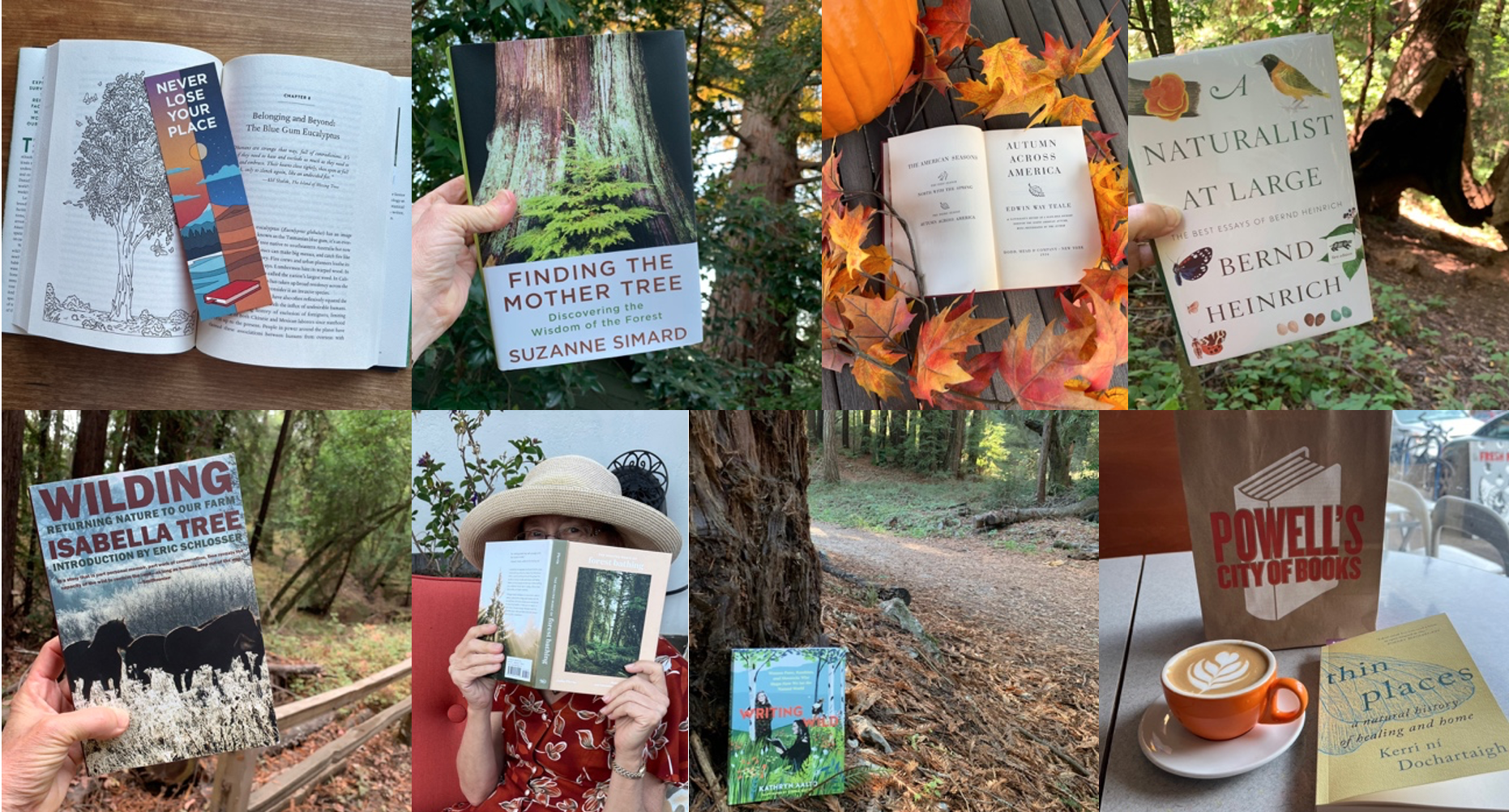
The narrator of Louise Erdrich’s novel The Sentence keeps a stack of Hard books and Lazy books by her bed. Unlike Tookie, I have only one pile somewhere in between. I learned long ago not to read a juicy novel right before bed at risk of staying up too late and being a zombie at work the next day, but in the vast realm of nonfiction it took me ages to discern what sort of books might soothe without being soporific. Philosophy is too demanding at the end of the day, politics and much history too potentially distressing; literary criticism put me to sleep too soon. Then The Hidden Life of Trees found its way onto my nightstand bookstack. The ways that trees communicate with each other are so fascinating I stayed awake till the end of each chapter and then drifted off to sleep with images of the forest in my mind. Nature writing turned out to be the ideal genre for my bedtime reading.
Imagine my dismay then when I learned that some critics consider nature writing a “bourgeois form of escapism.” In reply I could point to the solar panels on my roof and the electric car in my driveway to show that I’m not fiddling while Rome burns, but that might just seem like bourgeois environmentalist bragging. Still, the nature books I read before sleep are more than the literary equivalent of chamomile tea. They feed a soul that has found solace in the outdoors since childhood, a woman who hikes and gardens. From classics like A Sand County Almanac to contemporary essay collections like Helen Macdonald’s Vesper Flights, these books do more than put my mind at rest before bed. They stir in me a reverence for nature that plants me firmly on this earth and makes me want to protect it.
Nature writing also puts daily life and the very real woes of the world in a different perspective. Though not a replacement for being outdoors, it helps me feel connected to something larger than myself, a web of life in which I have a home – and at the end of the day a place to rest.
What does it mean for me to be an American patriot when the President of the United States announces that he hates me? (Or at least hates the people I voted for?) I used to mistake patriotism for the pure pride I felt as a kid in 1976, sporting red, white, and blue bell bottoms and waving a flag at the 4th of July parade. The bicentennial was also the year I memorized the preamble to the Declaration of Independence and still took for granted my right to life, liberty, and the pursuit of happiness, when I still believed the flag really did stand for a nation with liberty and justice for all. But patriotism, I have come to realize, is more than a swell of emotion.
The reason the President gave for hating Democrats was that we hate America, but he’s wrong about that. I love this country: its natural beauty, the diversity and energy of my fellow citizens, our long history of fighting for freedom. (Though not exclusively) I love American food, music, movies, and literature, and to this day a unique rush still sweeps through me in that moment before a baseball game when I stand and doff my cap for “The Star Spangled Banner.” As with any friend, however, I acknowledge this country’s shadow while also honoring what I love about it.
Our original sins of genocide and slavery, largely unconfessed and yet to be redeemed, cast a long shadow indeed, dark not just with the anguish and fury of the aggrieved but also the defensive entrenchment of those who want to believe no harm was done, want to believe that soldiers who massacred Lakota people at Wounded Knee deserve Medals of Honor and that a photo depicting an enslaved man’s scars should be removed from the Smithsonian because it reflects “corrosive ideology.” Yet even as I shiver in this shadow and wonder about reparations, the stain of our sins doesn’t erase all that I admire about my country. I love that our crown jewels aren’t displayed in a tower or museum. They are the national parks open to all, our civil rights guaranteed in the Constitution. Is it a stretch to say that in acknowledging the worth and dignity of the human person, the Bill of Rights is a formal, political way of expanding the golden rule, that fundamental guideline most of us learned in kindergarten? Found across world religions, in the Christian tradition it’s part of Jesus’s Sermon on the Mount: do to others as you would have them do to you.
My first promise to myself after the 2024 election was to be a citizen witness – to pay attention to what is happening even when it makes me weep or terrifies or outrages me. Like a nuclear technician with a Geiger counter, I exercise cautious discipline in my news consumption and try to set aside the newspaper or podcast before the tidings reach toxic levels. Likewise social media: I haven’t blocked the friends who disagree with me, but I am strict about checking each platform no more than once a day. Even this level of witnessing exacts a cost, no doubt familiar to you, dear reader: not just an emotional toll but also moral injury. To replenish my reservoir, I fill it with the antidotes I wrote about in “Coping with Chaos and Calamity:” perspective, nature, community, and joy in the everyday pleasures that come my way.
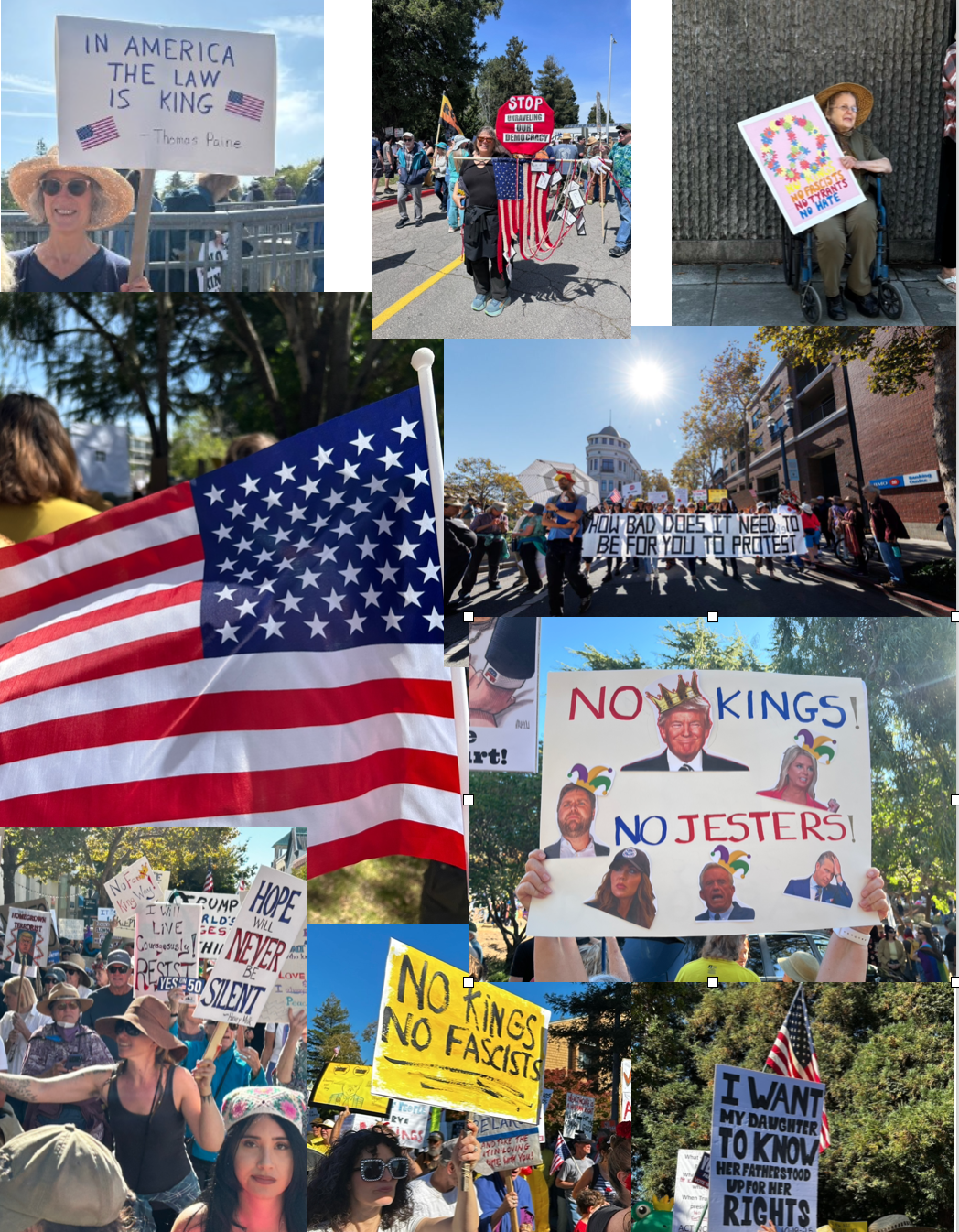
My commitment to be a citizen witness is moving me towards patriotism as a practice rather than a feeling. In hindsight, the first and maybe most important responsibility of a patriot I’ve actually been fulfilling since I was 18: voting. Other steps folded into the routine of my daily life: obeying the law, paying taxes, teaching college students how to find and evaluate information, trying to love others as myself. This year of broken promises and disregard for the Constitution has demanded more action. Along with millions of my fellow citizens, it has called me to the public square in nonviolent protest. The people I march with, friends but mostly strangers, come from various faiths or no faith at all. Our sundry signs carry different slogans but have a common theme: dismay at repeated and callous violations of the golden rule.
Lately I’ve been noticing more US flags at protests. Some are upside down, a traditional signal of distress, and many are right side up, a sign of patriotism and a reminder that the flag doesn’t belong to MAGA any more than the cross does. I have never loved my country more than I do now that I see a democracy I took for granted slipping away. Maybe part of growing my patriotism is reclaiming the cross and the flag.
When I looked up the symbolism of the Stars and Stripes, I found this quote from Ronald Reagan: “The colors of our flag signify the qualities of the human spirit we Americans cherish. Red for courage and readiness to sacrifice; white for pure intentions and high ideals; and blue for vigilance and justice.” I don’t know yet how much courage I will need or what sacrifices I might have to make, but my intentions are pure. The qualities President Reagan mentioned are the values I want to carry with me in my determination to honor and defend what I love about my country.
For many years now I have become increasingly reluctant to wear a cross necklace in public, not because I am ashamed of my Christian faith but because I’m afraid it will mark me as something I am not –- one of those people, as David Brooks put it, who “have crosses on their chest but Nietzsche in their heart—or, to be more precise, a high-school sophomore’s version of Nietzsche.”
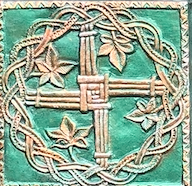
Today, September 14th, the Catholic Church (along with Anglican and Eastern Orthodox Churches, I learned from Wikipedia) celebrates the Exaltation of the Holy Cross, a special feast day for my home parish of Holy Cross in Santa Cruz, California. My non-Christian friends may find it strange to exalt what they see as an instrument of torture and death, and I can’t blame them. In the Roman Empire crucifixion was a brutal method of execution meant to instill fear, and the cross was a symbol of their power. But for early Christians it came to represent the great love story that was the origin of the Church: the love of Jesus who laid down His life for his friends.
No one has greater love than this, to lay down one’s life for one’s friends. – Jesus (John 15:13)
To say that the cross symbolizes love might seem simplistic and vague, so I’m turning to Jesus’s own words for insight on how to be a little more specific. When I read the Gospel, it seems that for Jesus, love meant solidarity with the poor in spirit and pure of heart, with the meek and merciful, and with peacemakers (Matthew 5: 1-12). He asked his followers to feed the hungry, clothe the naked, and look after the sick, even to invite the stranger in and visit those in prison (Matthew 25: 34).
I confess to you, dear reader, that I am far from living up to this call, but that’s what I aspire to. If you notice the Brigid cross in my garden or see me wearing one around my neck, please know that it’s not a political statement. It simply means that I am choosing love over fear.
Once a year, midwinter, a question starts percolating in my mind: what should I give up for Lent? These days I also wonder how to steady myself as a citizen witness in a time of chaos and discord when men in power willfully inflict suffering. On Ash Wednesday my answer boiled down to resistance. Instead of fasting from candy or alcohol, I stopped shopping at Amazon and withdrew from Facebook and Instagram.
Will my individual action make a difference? Honestly, no. Boycotting companies owned by oligarchs can’t be effective unless some critical mass of consumers join in and sustain the embargo for as long as it might take – like the bus boycott or the UFW grape boycott. And would scaling up be a fair ask? Lots of people rely on Meta platforms to promote their businesses, and online shopping is a lifeline for the homebound — not to mention all the employees who depend on these companies for an income. Lent has made me realize how lucky I am. Shopping local and taking a break from social media for forty days haven’t turned out to be much of a sacrifice.
The forty days before Easter are not just about giving something up though. Fasting is meant to be joined with prayer and almsgiving, an intertwining of traditional practices that braid action and contemplation. This Lent has brought me new prayers: a friend taught me to chant the Mangala mantra, which includes the plea, May the leaders of the earth protect in every way by keeping to the right path,* and Abbey of the Arts introduced me to earth psalms. Meanwhile, an old prayer has become more heartfelt: deliver us from evil. To whom shall I give alms? I have only to pose the question for answers to come. Last week I got an email from Second Harvest Food Bank asking for help as they try to “overcome the challenges created by recent shifts in U.S. policy, including federal funding freezes that have disrupted our food supply.”
With its threefold practice of fasting, prayer and almsgiving Lent has given me hints for how to be a good citizen. The personal is political, and, as it turns out, the spiritual is too.
* Translation from Sri K. Pattabhi Jois, Yoga Shala Nashville. I’ve also heard this translated May the citizens, lawmakers, and rulers walk the right path.
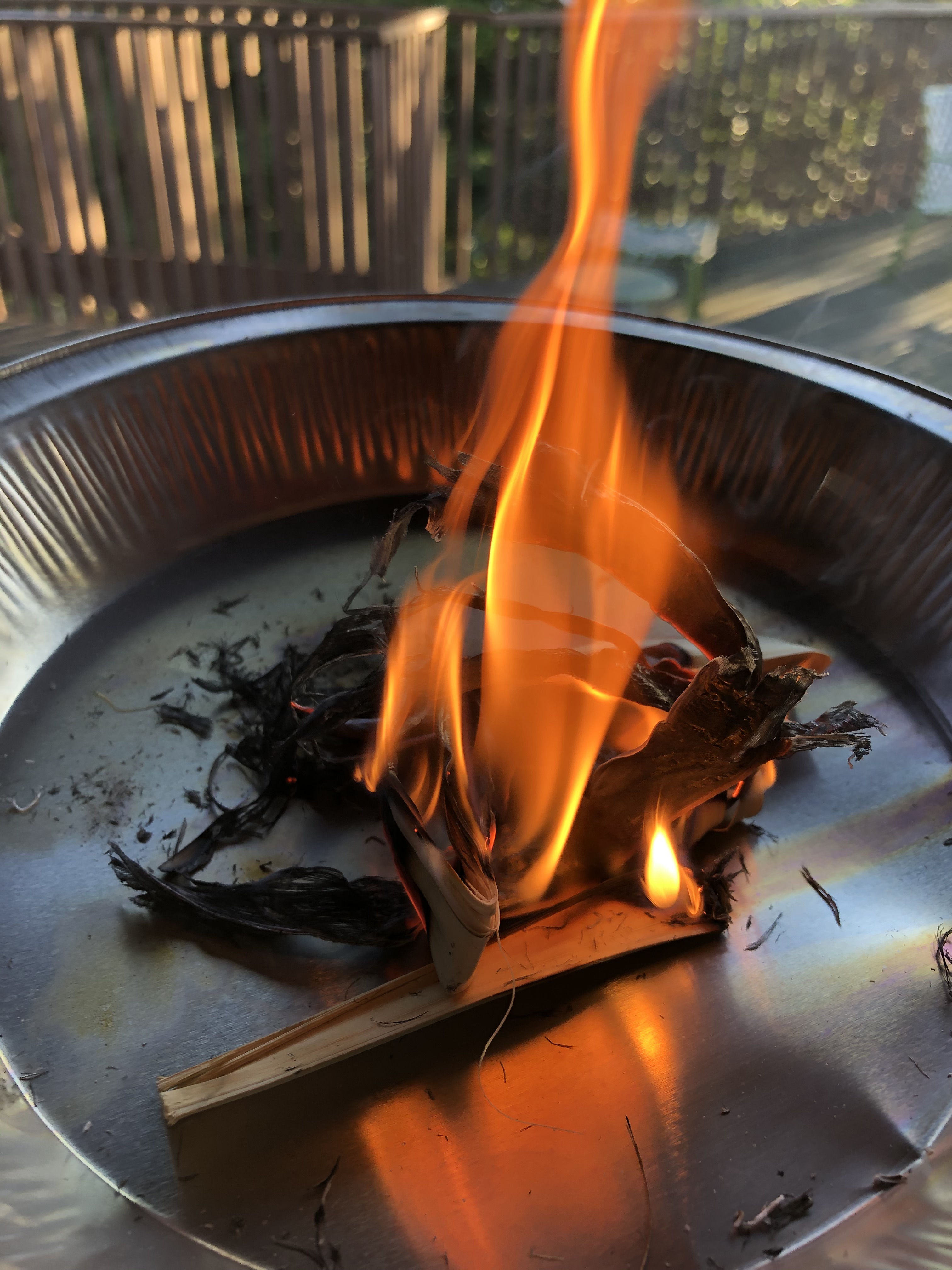
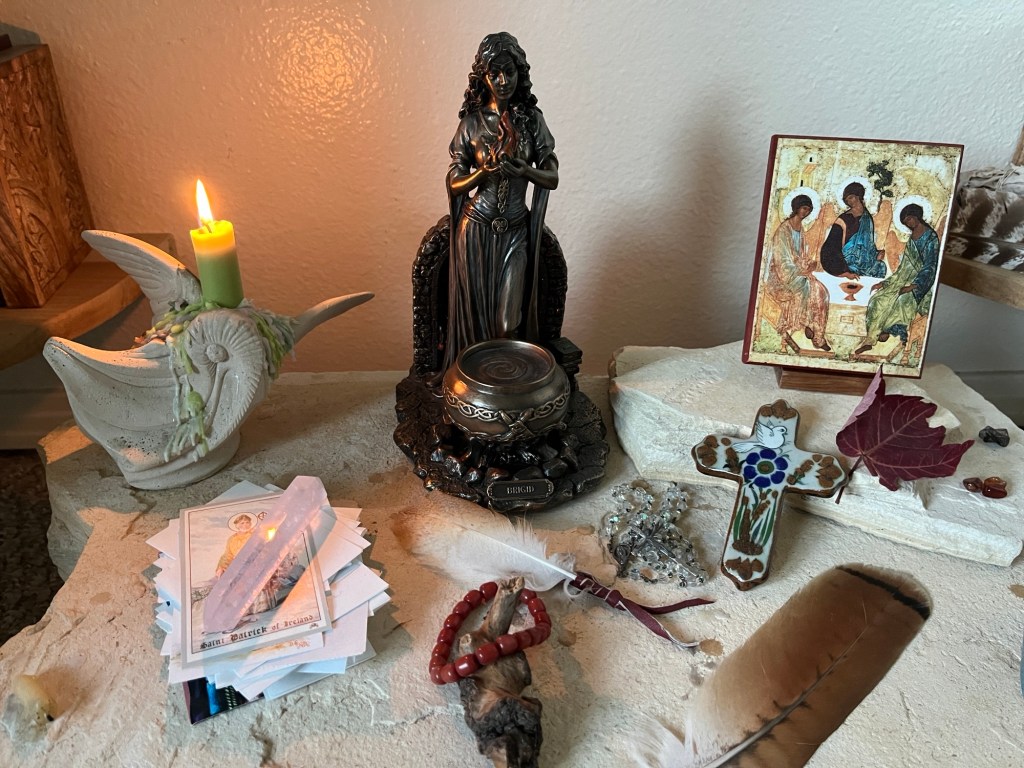
Some days it seems the only happiness to be found is in the elusive oblivion of sleep. On those days the price for staying awake is high, tears the only outlet for a toxic broth of fear and rage against disaster I’m too small to change. When I feel like my kayak has capsized in the rapids, I try to return to the ritual of lighting a candle to Brigit, a ritual that symbolizes and feeds my faith in the light — that Great Love that kindled my inner flame, that light that can overcome any darkness. Then I’m a little better able to see difficult feelings as potential tools for survival: fear warns of danger, anger powers action, tears are a vital expression of sorrow. To balance and bear these emotions I’ve learned some coping strategies from friends over the last few months that help me access the light and nurture my inner flame.
1. Keep things in perspective.
The sweep of history is long, holding meteor strikes and ice ages, the rise and fall of civilizations, cities destroyed and rebuilt. Positioning the current calamity on that long arc lets you view it in a different way — it may be overwhelming now, but it won’t always be. In my late thirties infertility and divorce seemed like the defining events of my story. Now at age 63 they are simply chapters in a much longer book. If this is the case with a lifetime, it is even more so for a country. In just 250 years the United States has witnessed a successful fight for independence from empire and civil war; Americans saw the excess of the Gilded Age give way to the corrections of the New Deal.
To be clear, the suggestion to keep things in perspective comes with a few caveats. For one thing it can feel limited to the privileged. Perspective might not be available to me if my home had been bombed or burned, if I had just lost my job or feared being deported. Nor should it provide false comfort that things aren’t really that bad. “Pay attention” was Mary Oliver’s first instruction for living a life, which means noticing goodness and beauty but also recognizing tragedy and treachery. Perspective doesn’t minimize calamity, it places this knot of suffering in a larger tapestry. Yes, what is happening now is unprecedented, but as a friend told me recently, we’ve been here before, and we know what to do.
2. Seek sustenance in nature.
My favorite tree when I was growing up was the pine in our backyard. In my essay “The Secret Forest” I describe it as “a bit of the wild in our tract house neighborhood where my sisters and I could climb, build a clubhouse, or imagine elves and fairies. The green needle canopy of that single pine, its sappy branches, duff carpet, and unique scent formed an entire arboreal world, Sherwood, Narnia, Fangorn Forest. And when I tired of company and play, it became a place to hide out, just the pine tree and me, my first hermitage.” Even as a child I understood the solace to be found in nature.
Now more than ever, go outdoors and open your senses wide. Try closing your eyes. What do you hear? Smell? Take off your shoes and find a place to plant your bare feet. As I write, I’m imagining the sensation on my soles of hard-packed sand, cushiony grass, moist and loamy garden soil. Walk among the trees. Press your forehead to the trunk of the redwood and lay yourself down in her duff. If you don’t have a place nearby to forest bathe, look up. On busy days, I like to take what I call “sky breaks” to savor for a moment whatever that immensity above me has to show.
3. Lean into community.
Even an introvert like me needs community. Now is the time to seek deeper connection with yours. Another caveat: social media might not be the best way. Instead gather with friends, go to church, play pickleball. I see people around me engaging in all kinds of ways: singing in a choir, taking a dance class, volunteering, joining a protest. Does all that sound ridiculously beyond what you have the capacity for right now? Text a friend and ask her to light a candle for you. (Or email me, my candle is ready.) Next week you might have the energy to meet for coffee.
4. Find joy in the ordinary.
For several months last year, caring for my aging parents meant spending more time than I ever had before in the emergency room and ICU. My sisters and I were inundated dealing with doctors, insurance companies, and attorneys, trying to arrange at-home care and then assisted living, reacting to one crisis after another. In the midst of this, my mother shared advice that her spiritual director had given her when Mom was caring for my grandmother. You might expect a nun to encourage you to honor your parents or pray the rosary, but that was not this sister’s approach. Instead, she advised my mom each and every day to look for joy.
When I tried it, I had the same experience Ross Gay did when he started writing an essay everyday about something delightful. He discovered “that the discipline or practice of writing these essays occasioned a kind of delight radar. Or maybe it was more like the development of a delight muscle. … Which is to say, I felt my life to be more full of delight. Not without sorrow or fear or pain or loss. But more full of delight.” Now the same thing happened to me: I developed a joy radar. A perfect feather from a hawk on the wing floated down into a crosswalk just as I was about to step off the curb. A friend’s baby granddaughter flashed me a bubbly smile. Soon my sisters and I were texting each other our daily joy, multiplying the effect.
***
As I struggle for equanimity, I find encouragement in a letter written almost two thousand years ago: “Let us lay aside the deeds of darkness and put on the armor of light.” This was St. Paul to the early Christians in Rome, and by light he meant love. Why then does he choose such a martial metaphor? I personally would rather draw a cloak of kindness around me than put on a suit of armor. But choosing love in challenging times takes great courage and fortitude, and I want to feel protected when I go out into the world, not by weapons, not by metal, but by light — the great love that kindled my inner flame.
Nature, community, joy — it may sound corny, but these are rays of light, and you can probably see how they feed each other. Moments of joy are highly likely when you’re stargazing or line dancing at the community center. In the life of a redwood this moment is a blip, and connecting with the world beyond your immediate crisis can shift your perspective.
Darkness does not have the last say. No matter what happens you are held in the great web of life.
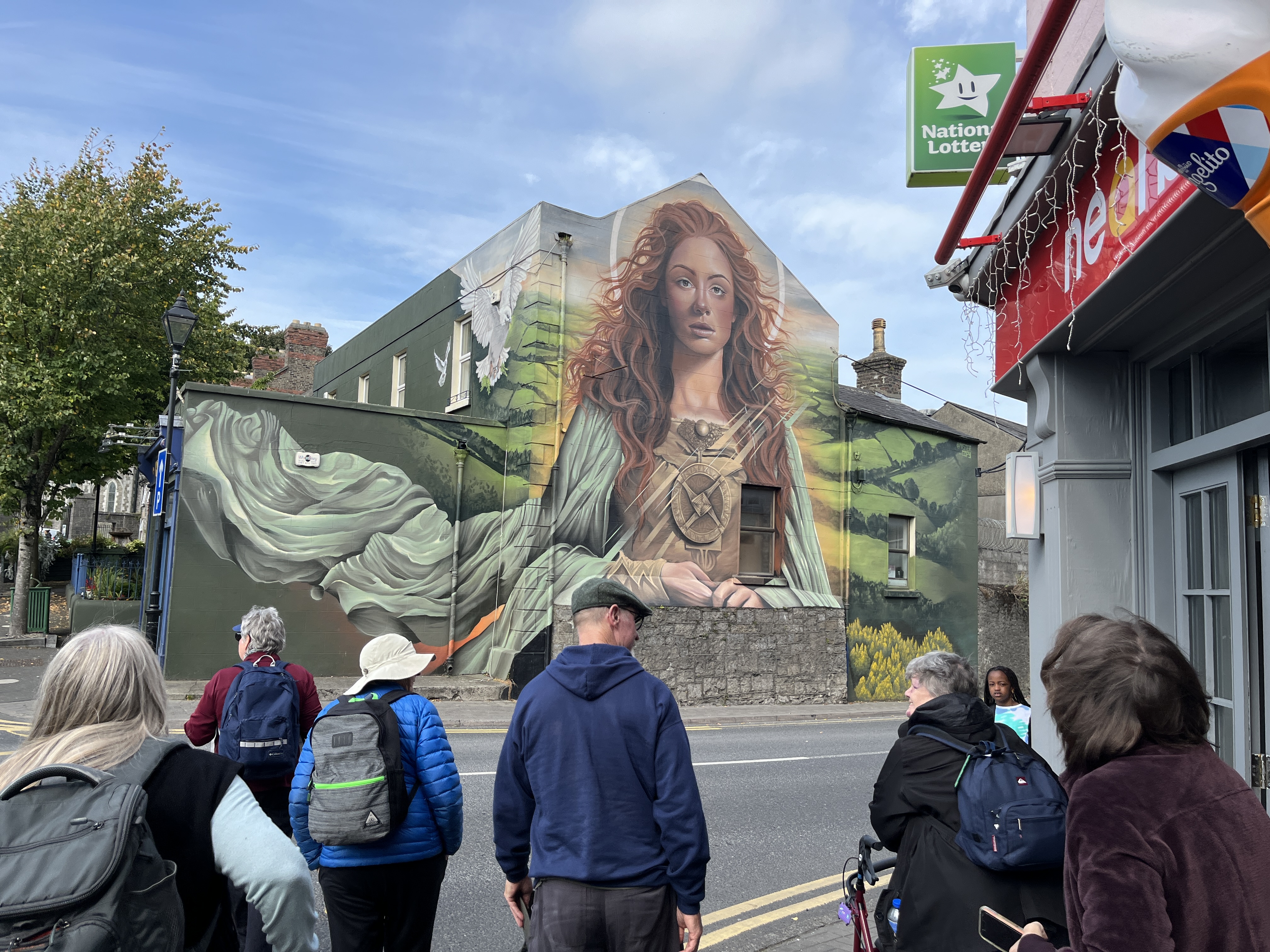
Strolling through the center of Kildare, you can’t help stepping into Brigid’s footsteps: this figure revered as Celtic mother goddess and Christian saint smiles at you larger than life from murals on McHugh’s Pharmacy and the Firecastle Pub. Since 2012 I have been part of a circle in Santa Cruz acting to keep Brigid’s legacy alive, so it was with the spirit of a pilgrim that I spent an afternoon around the corner from the pub at the site of the fire temple where a flame was kept burning in ancient times to honor the goddess and later the saint who bore her name. For centuries before and after Christianity came to Ireland, women tended that flame to the sacred feminine until it was extinguished during the Reformation.
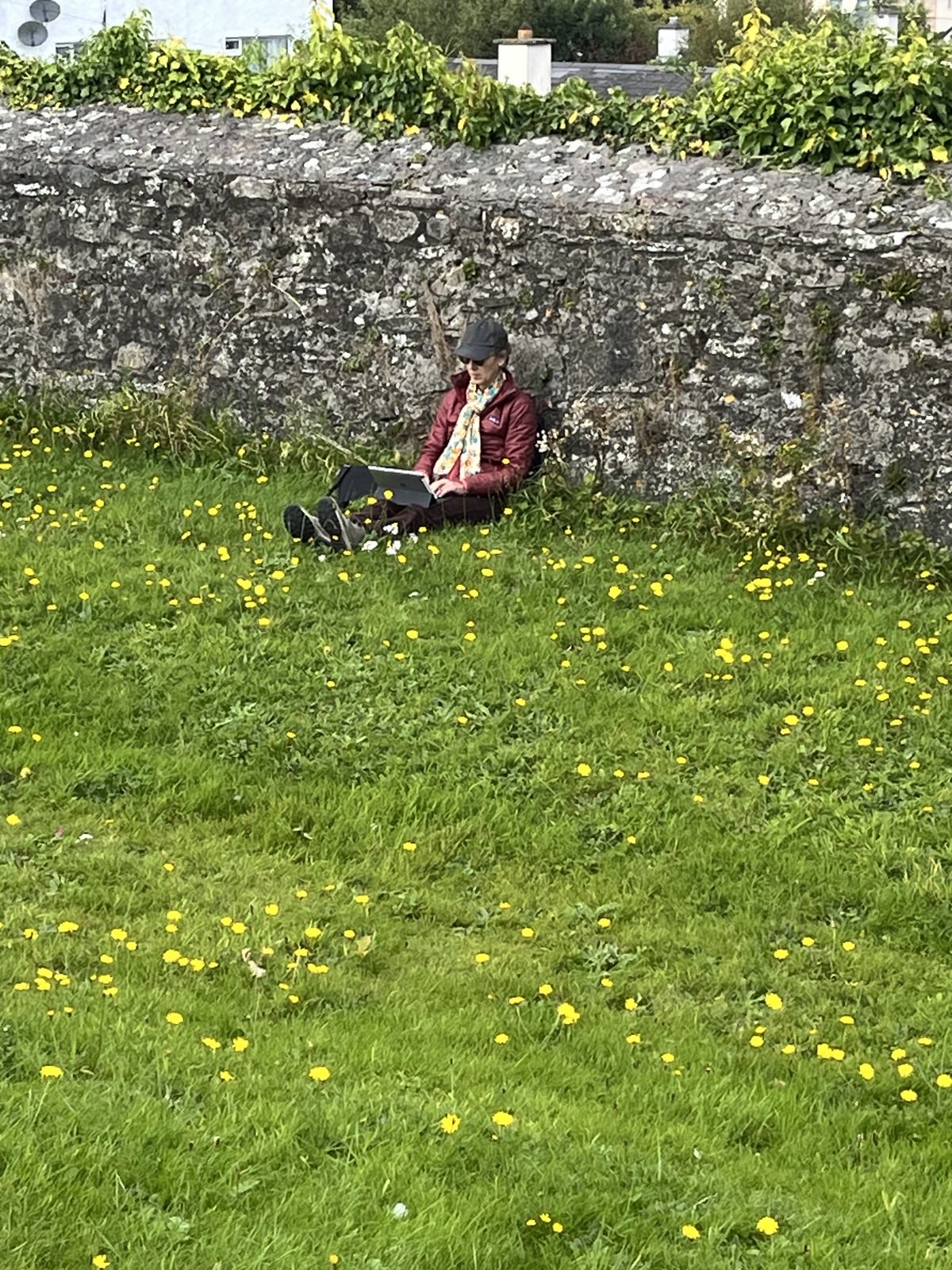
Photo courtesy of Carolyn Brigit Flynn
Leaning against a stone wall that marks the old boundary of St. Brigid’s monastery, I pulled out my iPad for some writing en plein air in a field of green grass dotted with white alyssum, yellow cat’s ear, and old gravestones. Gray clouds drifted across the sky, and birdsong mixed with the distant hum of traffic from town, clattering from the restoration of the medieval round tower on my right, and soft-voiced visitors drifting into the cathedral. Before me was the fire temple, surrounded by a short rectangular wall with stairs leading down to a depression in the earth, empty now as a breeze danced through the sea of yellow flowers. Once upon a time this enclosure might have been round instead of rectangular, formed by hedgerows instead of stone. Long ago it did not share this field with a Christian church and cemetery; now it does, a tangible reminder of how devotion to the goddess transformed into a fidelity acceptable to those in power, transformed, but in the red-hot heart of the fire, one and the same.
This is part of why Brigid appeals to me: she accommodates a Christian sensibility, and she holds the ancient impulse to honor the sacred feminine, just as that primal instinct lives inside me along with the Catholic tradition I was born into. In the heart of the fire and in my own human heart they are one and the same because each mirrors the spark of the One beyond all names and forms and even gender, the fire inside each of us meant to be the light of the world.
In 1992, as a new millennium approached, the Brigidine Sisters in Ireland began a process of discerning their mission which led to opening a small center for Christian Celtic spirituality in Kildare called Solas Bhride. A year later they re-lit Brigid’s flame in the market square of Kildare, carrying a spark of that flame to Solas Bhride where they have kept it continually burning ever since. Our retreat group spent a morning and an afternoon with the sisters there, learning about what Brigid can teach us today about caring for the planet, hospitality, peacemaking, and contemplation. The main building is constructed of circular rooms in the shape of a Brigid’s cross, and in a concluding ritual in the round room where a pillar candle burns with Brigid’s flame, we each lit a tea candle from that original ceremonial spark of 1993. As part of the Santa Cruz Brigid’s Circle, I take turns with eighteen other women tending her flame, and it thrilled me to carry the seeded wick of that little tea candle back to Santa Cruz to light my candle at home.
During those days in Kildare, it occurred to me for the first time that the real flame I’m tending is the one inside me – kindled by something greater than me but my responsibility to keep burning. How to do that? Fire needs oxygen and fuel. For each of us the fuel may be different. My flame feeds on contemplation and connection to community, nature, and the Divine. (Therapy, books and chocolate help too.) Fire can also be smothered or doused. I confess, this year anxiety has dimmed my inner flame, the big problems of the world that don’t diminish the little ones in my personal life even though I try to keep them in perspective. At two in the morning the challenges of my aging parents keep me awake as much as climate change and the political divisions cleaving our country. But when I’m anxious or afraid, my inner light can’t shine outwards the way it’s meant to. Maybe mindfulness practices like meditation and deep breathing, practices that calm anxiety and help put fears in perspective, are vital tools in the basket of a flame tender.
Years ago, when I was in thrall to some trouble I’ve forgotten now, a friend placed her hand on my chest and told me, “You can come from a place of fear or of love.” How many times did Jesus tell his disciples, be not afraid? This might have been more than a beloved teacher’s reassurance to his frightened friends and followers. Maybe it’s the prerequisite to the greatest commandment of all, a key for each of us to tending our flame.
As I write, we have just passed the midpoint between the autumn equinox and winter solstice with celebrations of Halloween, All Saints Day, Dia de los Muertos, Samhain. The days are getting shorter and cooler, and we may feel trepidation at the darkness ahead. How to tend my flame now? In a time of trouble when I am susceptible to fear, it begins with faith in the light. The feast day of St. Brigid is celebrated on February 1st, the cross-quarter day between the winter solstice and spring equinox known as Imbolc in the Celtic calendar when the goddess Brigid is also honored. At the beginning of February winter isn’t over yet, but we feel it yielding. Lambs are born, crocuses bloom, and sunrise comes earlier; light lingers a little longer each day. In this way Brigid reminds us (in the words of a song by Cyprian Consiglio): “There is a light that can overcome the darkness. There is no darkness that can overcome the light.” Even now our flames can be vibrant — especially when joined. The ritual of lighting a candle to Brigid both symbolizes and feeds my faith in that light. Fear is a bushel over the lamp. Love is the array of lighthouse mirrors that reflect it far out to sea.
I’m honored to introduce my travel buddy and beloved partner, Thomas Hood, sharing a little more of Ireland’s magic through his travelogue.
Upon arriving in Dublin it didn’t take long for the joyful embrace of Irish culture to entrance with its magic spell. Buskers, one after another down Grafton street, wove a musical tapestry, each with his or her mastered genre. Throngs of tourists and locals mingled together, doing a surprisingly deft dance as they gracefully squeezed through Dublin’s pulsing arteries. Back at our room in Townhouse on the Green, homespun hospitality greeted us like kinfolk and provided an elegant shelter from the storm of jet lag and the frenzied crowd.
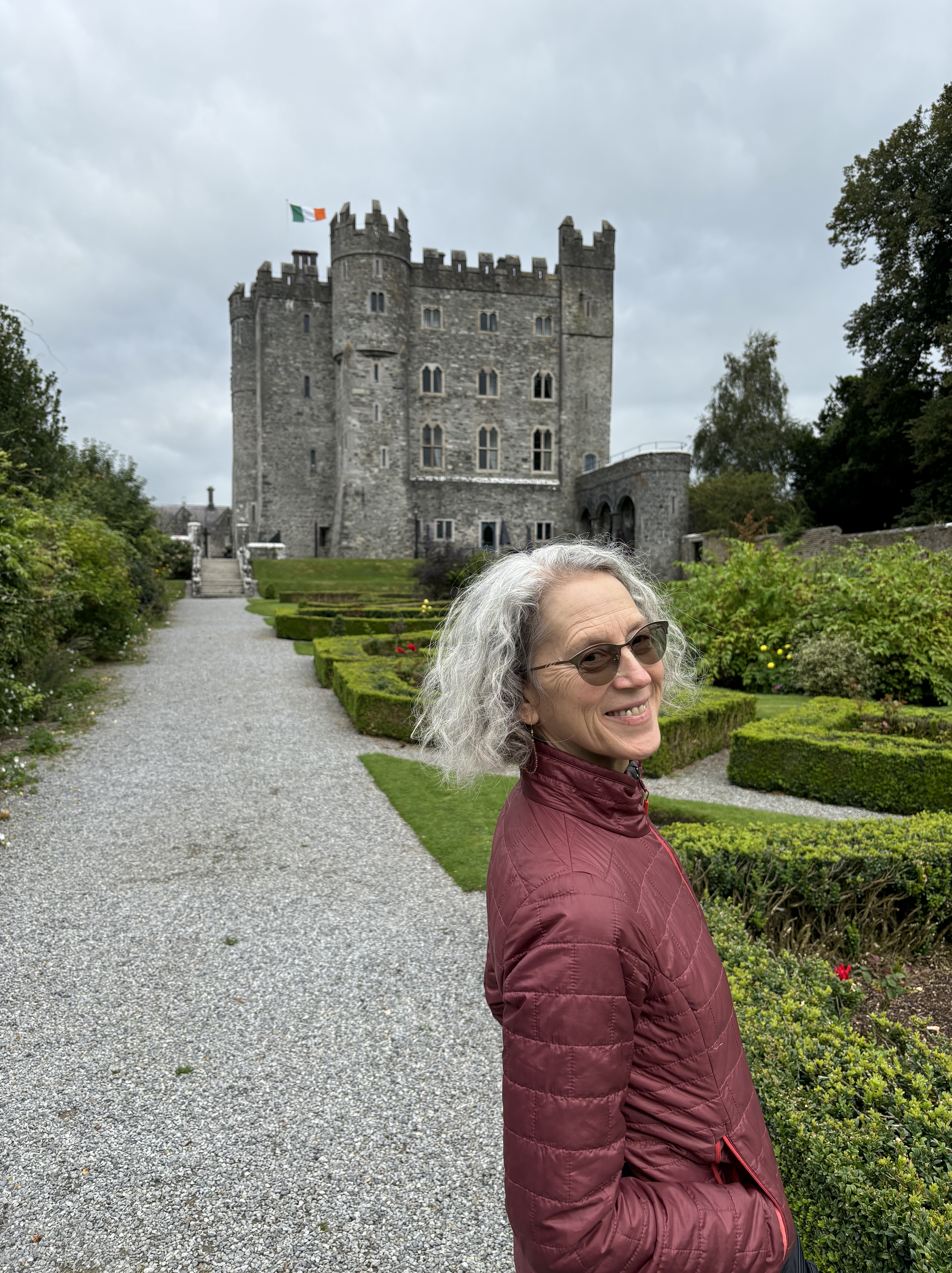
An abrupt Dublin day and half later, we joined a magnificent sisterhood, the writers of Flynn I shall call them, to bus our way to Kilkea Castle. The castle itself provided its own mystical magic as did getting acquainted with the sisterhood during our three days there. To walk through a castle, however altered through time, is to experience antiquity that we of the new world can only read about or see in film. Walking down the winding stumble-steps of a turret imagining marauders stumbling their way up, forced to switch swords to their left hands (all the architecture is designed to create advantages for the protectors), it’s easy to throw oneself back to the fifteenth century, protecting the realm.
Then we were off to the Beara Peninsula, piloted by Padraic who drives a bus as though it’s simply an appendage guided at subconscious level like an arm or leg. What lay ahead is a day I won’t forget.
It started with a golfing experience unlike any other. The Berehaven Golf Course encapsulates the ruggedness and beauty of the peninsula in its rocky escarpments and deep green undulating landscape that nature has delineated with rivulets, spillways, and endless wild inlets pervading the western coast line. We arrived without proper arrangement to find the jovial David in a downstairs room that looked more like an old horse race betting parlor than a clubhouse. He went into a dark musky room filled with clubs dating back thirty to forty years and piled together two sets of mismatched clubs. Perfect, uttered my playing partner, in all seriousness. As I tried to pay, David said, nah, just pay when you’re done, I’ll be out playing ahead of ya (leaving the ersatz clubhouse unmanned). The ensuing nine holes, while full of miscues, missed chances, and misjudgments, on holes with tees and greens hidden in unlikely places, was filled with wonder. These fabled lands, with singing stones, melodic rivers, and trees of wisdom, whether holding a golf course or Neolithic spiritual site, are full of wondrous sights, sounds, and mystical feelings.
While in some ways a silly superficial pursuit, golf, like many activities carried out on the land, can take you to a deeper place. One that requires a sense of harmony with the geography and an inner focus that can put you in a transcendent state of oneness with the battered club, the scruffy ball, and the trappings of landscape you might barely notice if simply walking through. Without your senses constantly assessing wind direction and speed, the height of the hills, the relative girth, height, and porosity of the tree in front of you, you’ll fail. You’ll fail even more surely than your lack of natural ability has already doomed the day or put at least at dire risk.
As we limped back to the makeshift clubhouse, really a pub in disguise, we felt the glory of tired accomplishment — a battle lost to the elements of land and sea but victory in our acceptance of unfamiliar difficulties and our ability to listen to the magic surrounding us. After a search through the underbelly of the dilapidated structure we wound our way to the top floor where we found David and his playing partners saddled up to the bar and a round of Guinness. I managed to leverage him away to take payment for all our rentals and golf rounds, and he said, oh how bout ninety five euro. If you were to place it in our area, a course in a hallowed location like this would cost twenty times that amount. My favorite golf experience in a long litany of courses, and it was practically given to us. A pittance charged, a spirit of generosity unmatched. Ireland.The Irish.
That same day, serendipity struck again. After dinner we were deftly Padraiged (the man deserves to be christened with his own verb) over the rugged Beara coast road to Jimmy’s Pub in the village of Allihies. The rumor of a Friday night gathering of local musicians was a siren song luring us away from our B&B in Castletownbere. We de-bussed, the sisterhood and I, and ambled through the pub door not knowing what to expect. Immediately we were thrown unceremoniously into a scene that would have been right at home in centuries past: a circle of of troubadours, poets,and performance artists, maybe twenty in all, basking in Celtic harmonies. These cherubic faces were lit with a particular joy I’ve seen only among musicians collaborating in the spontaneity of unrehearsed song. Outside the circle, locals listened intently when they weren’t heading toward or away from the bar until called upon to join in chorus.
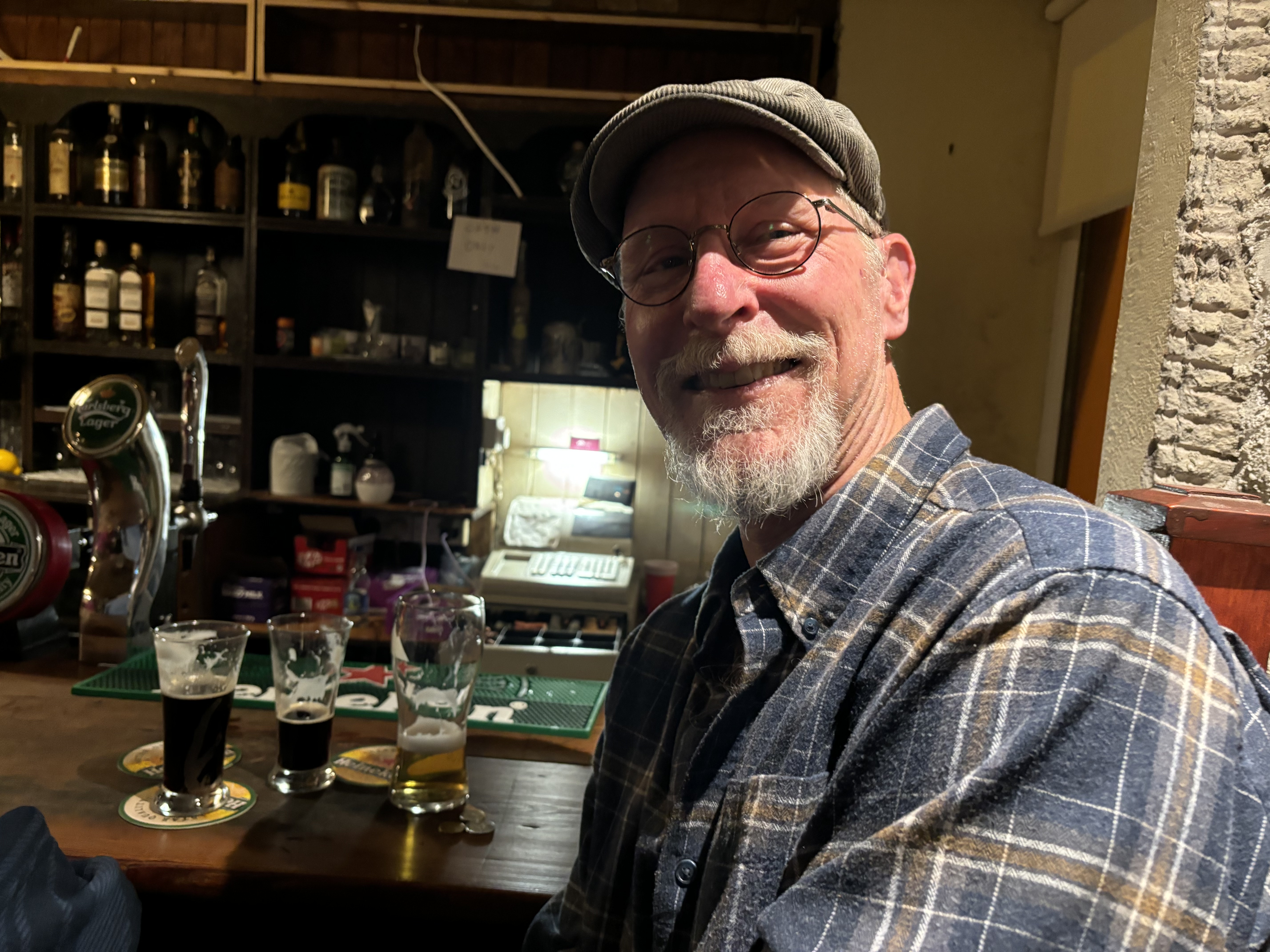
Immersion is my goal in foreign cultures, and spotting a seat at the bar amidst three patrons, I quickly bellied up and was encircled by the three. They were clearly local and regular given their countenance of casual comfort — not entirely due to their respective levels of insobriety. Finally getting the attention of the inundated barmaid Maureen, I ordered the sacred libation, Guinness.
Now, the Irish are not shy, and within a few seconds Billy, Dickie, and Mikey, were talkin’ me up. Men in their seventies with kid’s names, representative of the youthful spirit ubiquitous in Irish culture. We lovingly jostled one another with jibes and jokes while lively tunes wafted throughout the rustic pub.
Before long, one of the circle of artists stood up, her flaming red mane scattered down her back. With a presence that commanded the room she fell into a performance piece that captivated the by now unruly crowd. The Hag of Beara! (A local fable.) With the aid of a red coat thrown over her head she morphed into the Hag herself and led the captured choir in choruses between spoken words — words sometimes poetic, sometimes an improvised wilding. This was beyond anything I’ve seen in my decades of music festivals and plays. Context is everything, and here I’d been tossed into a setting that felt more fantasy than reality. Later I found out that the red witch of Beara has a PHD, and it was the first time she had ever done that sort of thing. Gobsmacked, I sipped my Guinness and sat in wonder. What next?
A myriad of tunes followed, and at some point, after a quiet pause, I heard a particularly alluring voice rise a cappella in Gaelic song. I stood, peering over Dickie’s head to see who this songbird might be. What?! It was one of the sisterhood singing a gorgeous Irish song…in Irish! How the hell did she get in this local jam, how did she know this long song in the ancient Gaelic tongue, and where did she learn to sing so beautifully? The answer to these questions and perhaps all such questions:“It’s just the magic of Ireland, lad.”
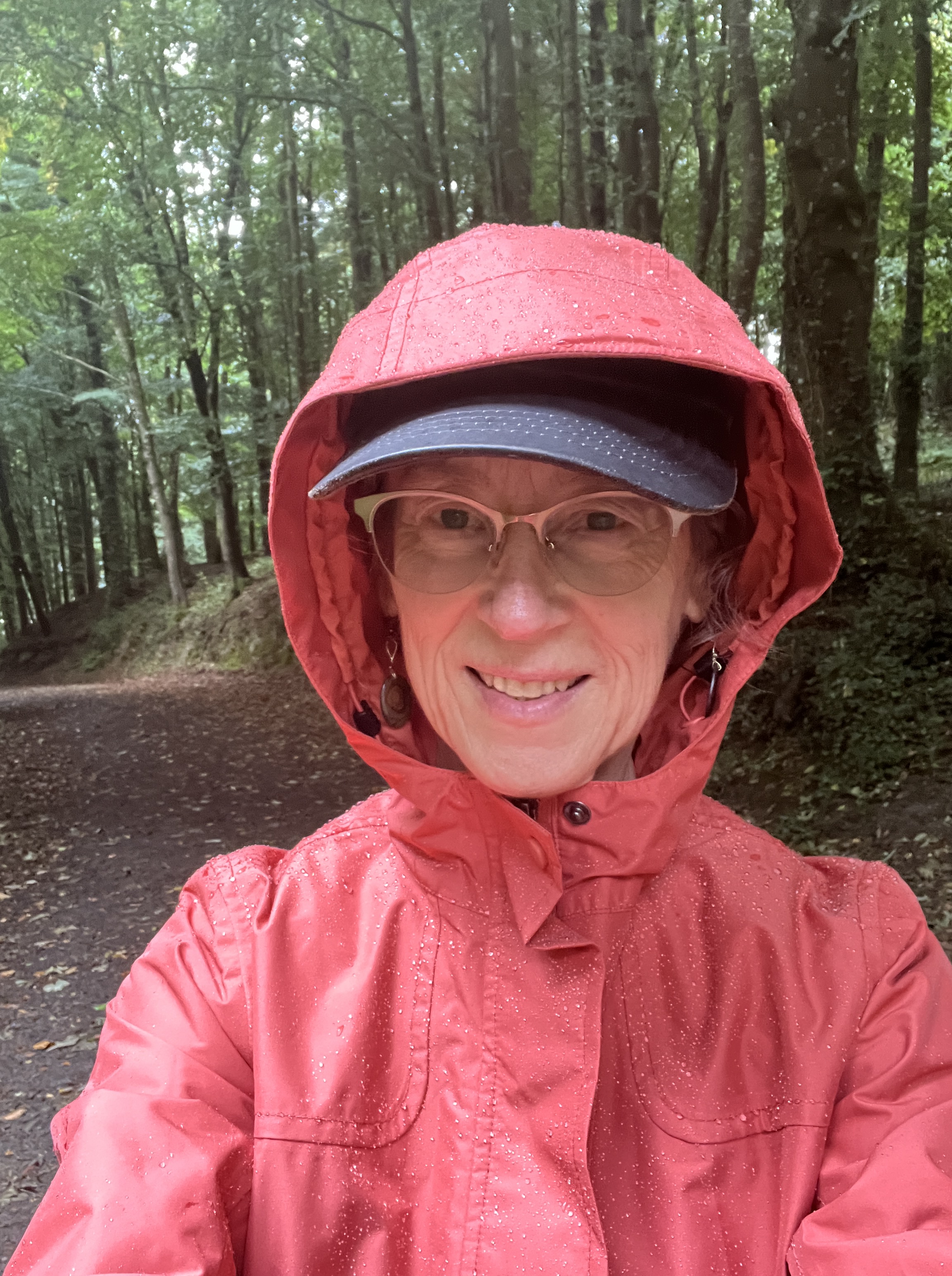
Walking in Mullaghreelan Forest on a free morning during my writing retreat in Ireland, I saw no one despite three cars in the parking lot. For the first time during my five days in the Emerald Isle I’d put on my new orange raincoat and was grateful for my waterproof boots. A gentle rain was falling, but here under the canopy of oak, beech, and sycamore I hardly felt a drop. The soft music of raindrops landing on broad leaves plied my ears, and fresh, moist scents filled the air, but I was comfortable and dry, like sitting on a porch during a storm except I was enjoying one of my great pleasures: a solitary walk in the woods. With only trees for company, my strong and sturdy legs moved down the path, no goal but the joy of movement and the necessity of returning to my starting point before lunch. I was in motion and at peace.
This is what my soul had been longing for: this moment in the Irish countryside, damp earth beneath my feet, trees sheltering me from the pearly gauze of rain indistinguishable from gray sky. I paused to listen. The sound of cars rolling down an unseen road, steady and rhythmic as the susurration of a distant sea, came from outside this place. Inside the forest I heard only the patter of rain and a single bird warbling. Leaves trembled when kissed by water drops, and it was as if the whole tree was shivering with pleasure …
I would like to end the story here, with my conscious mind recognizing the sacrament of the present moment and not with what happened next. It was so embarrassing I told no one, not even Tom, till weeks later: I got lost.
In the list of what to pack for the trip to Ireland our tour guide Carolyn Flynn had told us to bring a compass if we planned to hike alone. In all my years of hiking alone I’ve never carried a compass; it seemed excessive to add one to my already full suitcase, and there was nothing about Mullaghreelan Forest to suggest I might need one. The park was barely a mile across surrounded by farmland on three sides and the road to Castledermot on the other. I’d snapped a photo of the map at the entrance and set off down what looked like a main trail, certain it would be easy to turn around and retrace my steps when the time came to head back.
Enticing paths crisscrossed the park, and a half hour into my walk, beguiled by the woods and the rain, I decided to make a loop instead of going back the way I’d come. Maybe I’d find the wishing well I’d noticed on the map and expected to see by now. Except what I thought was a trail around the perimeter that would lead me back to the entrance petered out. I turned back to pick up a lateral path, but it too narrowed and disappeared. Okay, maybe the loop wasn’t such a good idea; I’d find my way back to a familiar path and retrace my steps after all. Yes, surely this broad leaf-strewn trail was the one I’d come down, but no, it hadn’t come to a T quite like this. Which way to turn? The roadway shouldn’t be far, but now I couldn’t hear any cars, only raindrops on leaves. I surely wasn’t in danger in a tiny park surrounded by occupied Irish countryside, but I hadn’t seen a soul since I entered. No one knew where I was.
Suddenly the forest seemed large, and stories drifted into my mind of the Fair Folk, those supernatural beings said to dwell in the invisible Otherworld that exists alongside our own. It had always been easy to shrug off tales of their mischief as a charming bit of Irish folklore, but now, alone in the woods, I remembered that to this day Irish farmers plow around ring forts and fairy mounds, that people cautiously avoid referring to the Good Folk by a name I dare not mention here (think Tinker Bell and a word that starts with F). Suddenly the stories seemed plausible, and wasn’t leading travelers astray one of their favorite pranks? Had I trespassed in some blundering American way? The longer I wandered, the more I wondered if I had fallen for their lures, easily tricked like the stranger I was. Why oh why hadn’t I brought a compass?
Then I remembered the phone in my pocket. I pulled it out and took it off airplane mode. Yes, I had four bars! Apple Maps located me in the forest and showed a way out. Relief and chagrin poured through me and also a good measure of gratitude – not to modern technology but to Themselves. I’ve no doubt they could have tinkered with my device or tampered with its tenuous connection to the internet if they had wished. Instead, they tricked and teased me just enough for me to know I’d been enchanted by the magic of Ireland.
I am deeply, happily at home here on the California coast where I was born, but my soul has a second home in Ireland, the land of my ancestors, and it is calling me. When I say Ireland, I’m not thinking of a country with borders but of a place like Yeats’s Lake Isle of Innifree
… where peace comes dropping slow,
Dropping from the veils of the morning to where the cricket sings;
There midnight’s all a glimmer and noon a purple glow,
And evening full of the linnet’s wings.
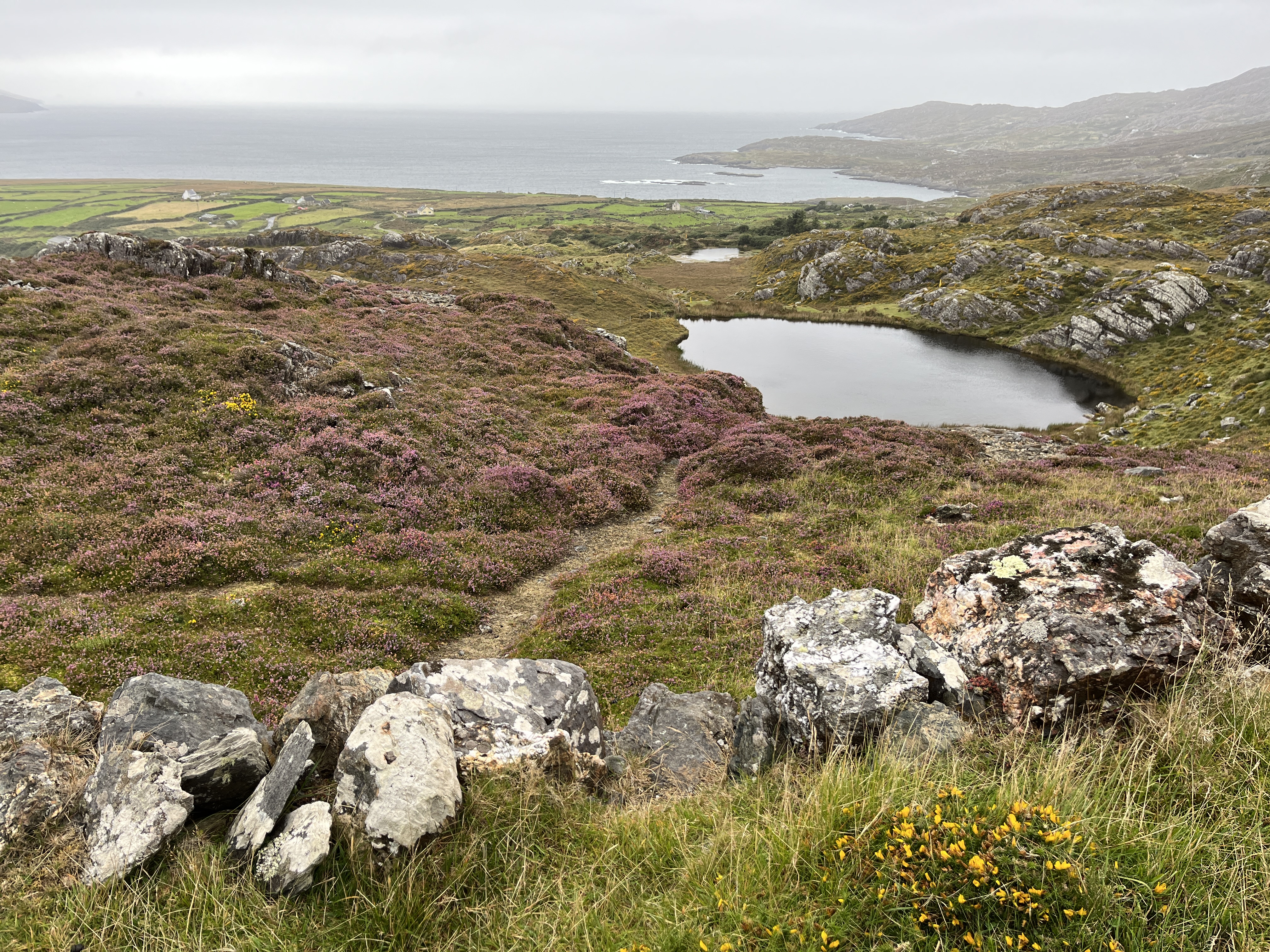
Ireland is more than a mythical, poetic place with an ancient name though. Tom and I traveled there for the first time in 2019; he has Irish heritage too, and both of us felt a surprising sense of homecoming. Was it a cellular memory of the geography or simply comfort among warm and welcoming people with good humor and a heart-lifting accent? I’m not sure, but I remember it vividly, and when I say that Ireland is calling, I mean that my lungs want to fill with the air rising from that mossy, rain-soaked island, air that has its own moist texture my cheeks want to be bathed in and a scent my nose is longing to smell. My eyes hunger for forty shades of green; my legs are eager to stride down a country lane between rock walls and across grassy fields. I can almost hear sheep bleating, waves crashing against sandstone cliffs, the silence that soaks ancient standing stones.
Ireland is calling, and I am answering. For many years my beloved teacher Carolyn Brigit Flynn has led writing retreats in Ireland she calls Landscape of Soul and Story, and for years I’ve heard rapturous reviews from returning travelers of beautiful country and ancient Celtic sites that inspired deep feeling and luscious writing. The 2016 group actually filled a gorgeous book titled Sacred Stone, Sacred Water with poems, essays, and art. I dreamed of going myself, but the tours were always scheduled in September to catch the best weather — just when I was always returning to Foothill College for the beginning of the academic year. Now, a year into my retirement my dream is about to come true.
Soon I will be in that place where my great grandmother prayed Ave Maria, where perhaps a longer ago grandmother tended a flame to the goddess Brigit, and an even longer ago grandfather helped raise one of those standing stones. All are waiting for me: lilting voices and gentle rain, ancestors and stones.
I will arise and go now, for always night and day
I hear lake water lapping with low sounds by the shore;
While I stand on the roadway, or on the pavements grey,
I hear it in the deep heart’s core.
It has been a hard season of injury, illness, and grief in my family, and I will carry that weight with me, knowing that Irish earth and stone can hold it. Travel is an art, Carolyn reports her tour-guide father saying. Along with extensive packing and travel details (Bring comfortable, waterproof shoes!) she offers suggestions to prepare our spirits for this journey: “make sure to have unencumbered time to allow your meandering/dreaming/writing self to emerge.” My bags aren’t packed yet, but I have the notebook I will write in. In my deep heart’s core I am ready for this pilgrimage to the land of soul and story.








 The Kingdom of Enough