The Holy Uninvited

After Psalm 138

henbit dead nettle

The weeds that withered and the ones I pulled

are risen in a flurry of flowers —

floods of maroon-tipped white ramping-fumitory

and meadows full of sunbright yellow oxalis.

Amidst last winter’s lettuce, henbit deadnettle flaunts

small purple velvet blooms

unfurling

yet smaller

speckled petals.

The beauty of what I call weeds

startles me into gratitude,

and I sing praise to the earth.

I name you, holy uninvited —

nettle and broom,

thistle and vinca –

and bow before your tenacious ingenuity,

for you glorify the Author of Life

in your surging greenness.

When I looked out my window, 

you showed me your loveliness;

your bounty reminded me of our plenty.

All the fearful would surely recognize abundance

if they could see the unstoppable

flowering in this garden,

if they only breathed in the aromas of 

sweet peas and angel’s trumpet.

Though the Beloved dwells in paradise,

She cares for the nettle and broom

as much as the jasmine and rose;

both planted and uninvited

are holy in Her sight.

Though I fear scarcity,

you fill this plot with hurtling life.

You offer enough to feed us all,

more than enough to save us. 

The earth will make good her purpose for me;

O Sacred Earth, your greening endures forever;

do not abandon the fruits of your flowering.


Audio version of The Holy Uninvited

a bouquet of weeds/wildflowers next to the book Psalms for Praying

A note about this poem: In January I started reading the book Understorey: A Year Among Weeds by Anna Chapman Parker, and it inspired me to pay attention to the weeds in my garden. Although oxalis dominates with its neon yellow flowers, when I set out to explore the verdant greenery currently burgeoning in my backyard, I identified twenty other species— many of which I would have considered wildflowers if I’d discovered them on a hike. And now that I know another name for oxalis is Bermuda buttercup, how could I not want to make peace with it?

Then last week, for an online retreat through Abbey of the Arts called Earth Psalter: Writing Psalms for the Anthropocene, I was asked to “bring an object from an outdoor place that is meaningful to your experience of your ecosystem.” Minutes before I was supposed to show up on Zoom, I raced out to the still dewy backyard with my clippers and put together a small bouquet of weeds/wildflowers that inspired this song of praise and gratitude.

Thank you to Abbey of the Arts for this new approach to the psalms!
Beholding Your Sanctuary

Photo courtesy of Sylvia Deck

My Grandma Sammie knew many psalms by heart and could quote them chapter and verse. Maybe she’s the one who inspired me one day almost twenty years ago to learn Psalm 63 (the first nine verses anyway). I studied it carefully to imprint the words on my memory.  When I came to the line, so I have seen you in your sanctuary, beholding your power and glory, I pictured my place of worship, Holy Cross Church, with its high ceiling and sunlight streaming through the stained glass windows.

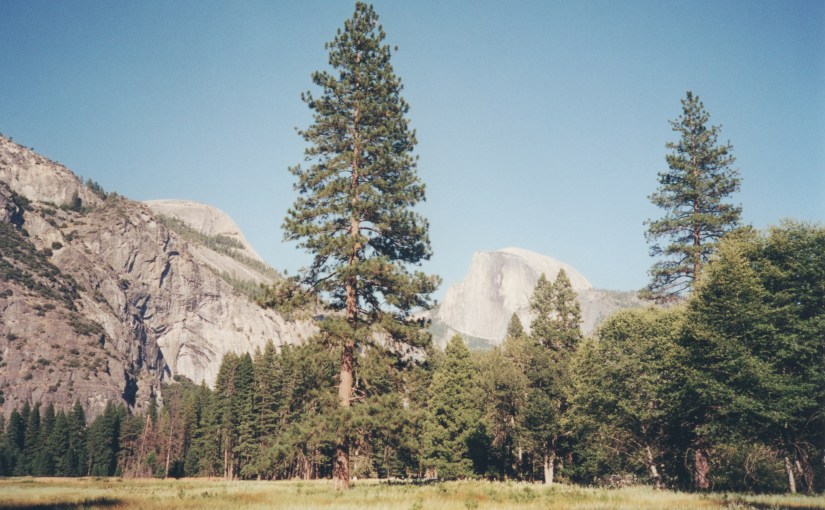
Then, to my surprise, my imagination leapt out of the building and into Yosemite Valley with the distinct curve of Half Dome and the craggy heights of El Capitan soaring above me. Yet maybe it shouldn’t have been a surprise. Isn’t nature as much the home of the Divine as my dear parish church? John Muir called the Sierra Nevada the range of light, and I visited those mountains every summer. Why wouldn’t my mind latch onto Yosemite as the sanctuary of the Holy One? Psalm 63 itself begins with sensual longing: my body pines for you like a dry, weary land without water. It set me up to conflate God with the earth.

I returned to the mental exercise of memorizing the psalm. My soul shall be filled as with a banquet … Now came another image to mind, the morning of December 21, 1999, the last winter solstice of the millennium.

That day I went out before dawn for a walk along the ocean cliffs in Santa Cruz. What was purported to be the brightest full moon in a hundred years was setting in the west, swathed in swirling mist. For forty-five minutes it was my beacon and companion, and I was in awe. Finally, just as I reached my turning point, it dipped below the horizon. Show’s over, I thought sadly and turned around to start for home. What I saw then nearly took my breath away: a gorgeous sunrise had stolen up behind my back and was now in full bloom across the bay. I had only to turn around to see fresh beauty on the horizon. Here was the generosity of the Beloved on full display, sun and moon playing with the earth in a wild dance that seemed a secret shared between them and at the same time a wanton display for all us creatures to see.

Before King David composed the psalms, we were given nature as a scripture. Praying Psalm 63 is a way for me to celebrate the written Bible and the book of creation at the same time. Both help me find my way into the cave of my heart. At a time when I no longer take clean air or our democracy for granted, this is not a small thing. It might seem like escapism, and yes, it is a respite — like a walk along the ocean is — but the intention is to return to face COVID, the fight against racism, and wildfires with a hope and compassion I don’t have on my own.

Merced River, Yosemite Valley

Where do you perceive the Divine? What invites you into the cave of your heart? These are deeply personal questions, but if you feel like sharing what gives you hope in troubled times, please reply in the comments.