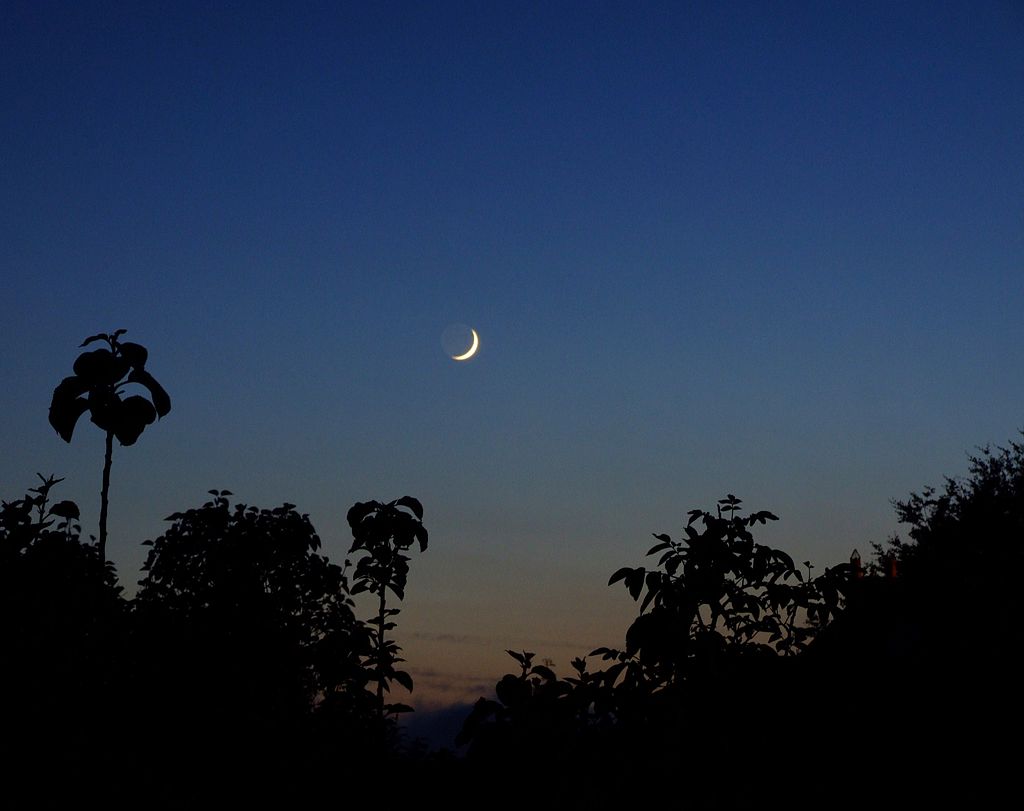
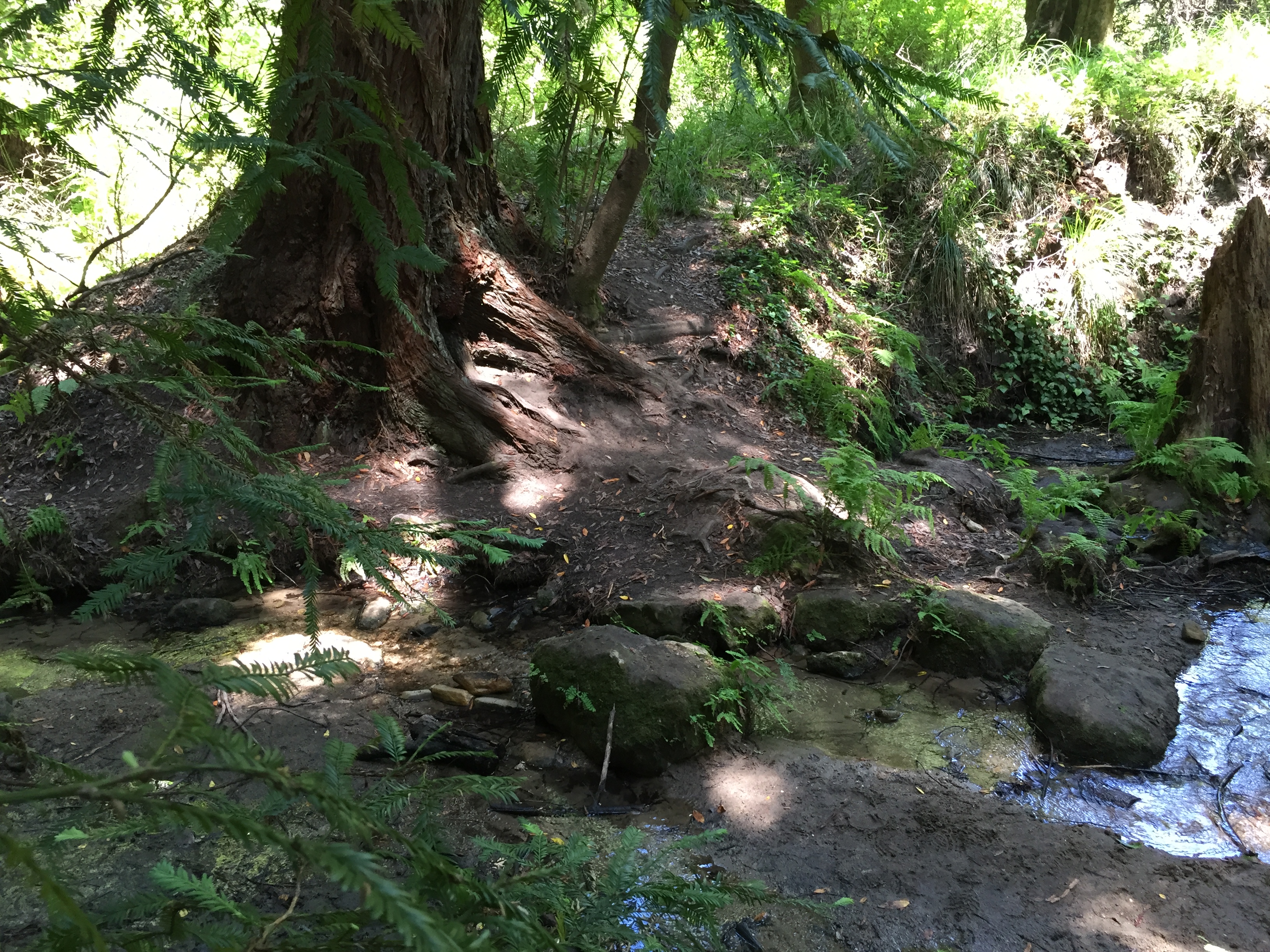
Tonight my mind feels like the new moon,
present in all her integrity,
but turning a blank face to herself.
She blends softly into the dark night,
pleased to hide among the stars,
and rest.
Tonight she doesn’t have to reflect light,
shine on dreamy lovers,
or inspire a single poem.
She wraps all her secrets up in the cloak
her grandmother wove for her
and tucks herself in,
knows that tomorrow she will begin
another waltz with the sun, and
sliver by sliver
the words to describe
the autumn light and the blue sky of November
will begin spilling onto the page
in a silver tumble.
Author: Mary Camille Thomas
From the Wellstone Center in the Redwoods
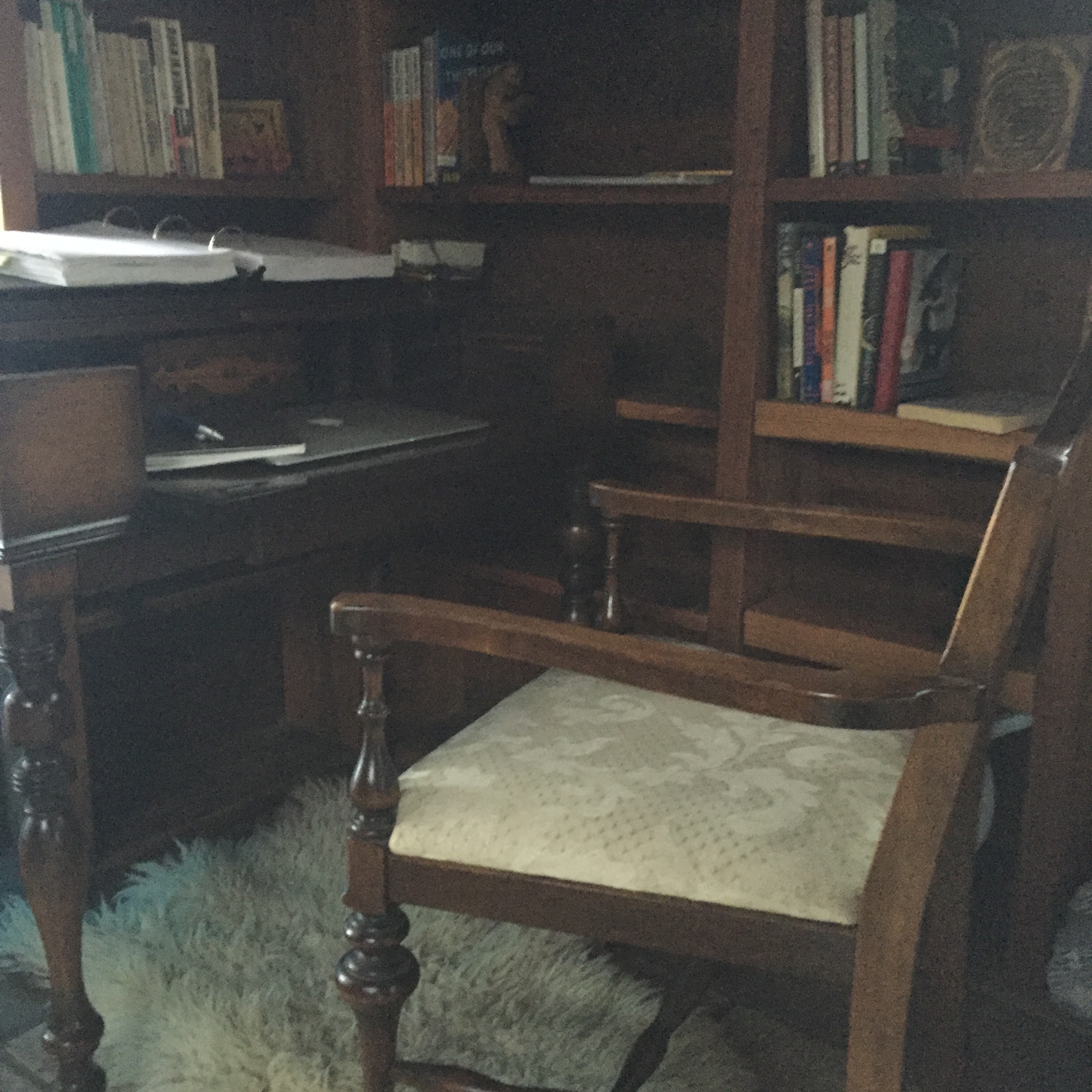
I’m at a writing retreat, staying in a rustic cabin with no electricity or running water called the Library House. Perched on a deck among oak trees, it felt like home as soon as I walked into its book-lined walls. I set my suitcase down and perused the titles before I unpacked, saw how thoughtfully they had been chosen and approved too of how they had been organized: travel, biography, poetry, entire shelves for favorite authors like Hemingway, Toni Morrison, Joan Didion, and a whole section just for fun. I had arrived for a weeklong writer’s residency, but was tempted to spend the next seven days devouring as much of this eclectic, enticing library as I could.
Instead, I settled at the desk with my laptop and a fat binder containing the rough draft of my novel. When darkness folded my little cabin into the night, I lit candles and at some point, despite my thick wool socks, noticed that my feet on the stone tiles were cold. Out came the sheepskin rug from under the rocking chair to lie under the desk instead. I have learned to move it around to wherever my feet are.
Home is a place you’ve made your own, usually by moving in with all your worldly goods, but sometimes just by rearranging what you find in your temporary abode. I know a monk who has traveled the world and feels at home wherever he lays down his yoga mat. Even a room in a Motel 6 can become a sanctuary.
I came here to write in solitude, away from the delights and distractions of my daily life, and found a tribe of writers with a place for me, a communal life that leads to contemplation and a contemplative life that nourishes community. We all have questions here. What is the very best word to write down next? What will I do when I leave this place? I want an agent or editor to tell me definitively whether I should start my novel at chapter 15 instead of chapter 1, but instead I sink into the ground made fertile by this balance of contemplative and communal. This is my home ground, this is where I can dig deep to find the answer.
The House of Truth Telling

A woman who lives in a house built on sand
tells time with a clock
though time doesn’t matter
because she isn’t at now;
she’s paying bills next Saturday
and buying sleeping pills at the drugstore
on her way home from work.
She thrives on the swarming bees of her appetites
because they’re the only thing that makes her feel alive.
I want to live in a house built on rock
where poems and prayers echo down the halls
and the undulations of my private rhythms
tell time in consultation with the sun.
I am neither nice nor mean here –
in this house generosity is measured
by how much truth you tell.
The rooms hold all you have to give;
the smoke of it wafts out the chimney
and blossoms into shapes as if the house itself
were blowing smoke rings into the fine cold sky
for everyone to see.
In the desk drawer of this house
the account book tallies silence,
its value when the heart yearns for it
and its cost when one with truth to tell
is hushed or drowned out.
In this house I am a servant with no master
and a queen with no subjects.
This house will weather storm and flood,
and an earthquake will rock it
like a babe in her mother’s arms.
The Murmurings of Roots
Will your cravings ever leave you,
lifting like a startled flock
from your naked limbs?
Will your mind finally come to rest,
one ordinary morning?
What might you hear in the sheer silence?
Your heartbeat –
and the squirrel’s,
the secret language of the garden,
what the earthworms say to the roots.
You were waiting for the voice of God,
and here in the cave of your heart
is the alleluia of the blackberry
at the moment it plumps into perfect ripeness
and the Deo gratias of the squirrel
as it plucks the berry from the vine.
Attune your breath to the cedar’s sigh
and rise from your cushion now
before the diamond dewdrops
on the sourgrass dry.
A New Asceticism’
Remember the character Silas in The Da Vinci Code? He wore a sort of spiked garter called a cilice under his clothes, and in between murdering members of the Priory of Sion, he privately flogged himself. You can think of him as a caricature of the old asceticism, based on the Platonic notion that the body is the tomb of the soul, an obstacle to be overcome on the spiritual path. Through fasting, celibacy, and the kind of harm Silas inflicted on himself, the ascetic hoped to free his or her soul from the cage of the body.
After a bout of anorexia when I was a teenager, I have mostly resisted fasting as an adult; it’s as if two years of crazy dieting was enough to last me a lifetime. Nor have I been given to celibacy or self-flagellation (at least not the physical kind!). So I was happy to see Cyprian Consiglio’s suggestions for a new asceticism in his recent book Spirit, Soul, Body: Toward an Integral Christian Spirituality.
The main topic of the book is what he refers to as a new anthropology, the premise that “each human being is not just body and soul, but spirit, soul, and body, three interpenetrating realms of our being human“ (p. 72). I often hear the phrase “body, mind, spirit,” but Father Cyprian deliberately uses the word soul instead of mind to encompass not just the rational mind, but “all the strata of the soul, the psyche – the subconscious, higher states of consciousness, the collective unconscious, and psychic powers” (pp. 73-74). And what is the difference between soul and spirit? Father Cyprian explains that “the soul has the potential to open to something more, which is the pneuma, the spirit, the point where the human spirit opens on to the Spirit of God, the universal Spirit” (p.74).
Because the human body is interpenetrated with soul and spirit, the new asceticism suggested in this book cares for the body instead of punishing it. Father Cyprian recommends, for example, a healthy diet and daily exercise, especially practices like tai chi and yoga that help us recognize and strengthen the mind-body connection. (Assuming, as I do, that the antioxidants in dark chocolate and red wine are good for you, I’m well on my way as a modern ascetic!)

Lest our spiritual practice become solipsistic, however, this new asceticism also asks us to think about the environment and social justice. Spirit, Soul, Body was published before Laudato Si’, the papal encyclical “on care for our common home,” but they share these themes. While a biologist can easily make a case for protecting the environment – we are part of the interconnected web of life on this planet, and what’s bad for the biosphere is bad for us too – Father Cyprian and Pope Francis argue in addition that the earth is sacred, and like the human body interpenetrated by soul, it is to be reverenced. The pope considers “soil, water, mountains: everything …, as it were, a caress from God” and goes on to quote the bishops of Brazil: “nature as a whole not only manifests God but is also a locus of [divine] presence. The Spirit of life dwells in every living creature and calls us to enter into relationship …” (¶ 84 and 88). Caring for the environment and working for human rights are sacred work.
So, as a practical matter, what does a new asceticism look like? Father Cyprian mentions a friend who uses the acronym SONG to help answer this question: “through our yoga, we reestablish right relationship with Self, Others, Nature, and God” (p. 112). As I consider my own life, I think I’m pretty good at self-care, but I need to focus a little more on the ONG in this spectrum. What if I gave away as much to charity as I spend on clothes? Shopped more at the farmer’s market and brought home less plastic packaging from Trader Joe’s? I could start composting, help out at the next beach cleanup, abstain from meat at least once a week (just like Lent!). And even though the new Mazda Miata I’ve noticed in the parking lot at work is gorgeous and enticing, maybe, just maybe, my next car will be hybrid or electric.
All around me is inspiration: the acquaintance who teaches nonviolent communication in prisons, friends who are vegans and vegetarians, my sister and brother-in-law who cycle almost everywhere they go. Please leave a reply if you’d like to share a practice that helps you stay in right relationship with self, others, nature, and God.
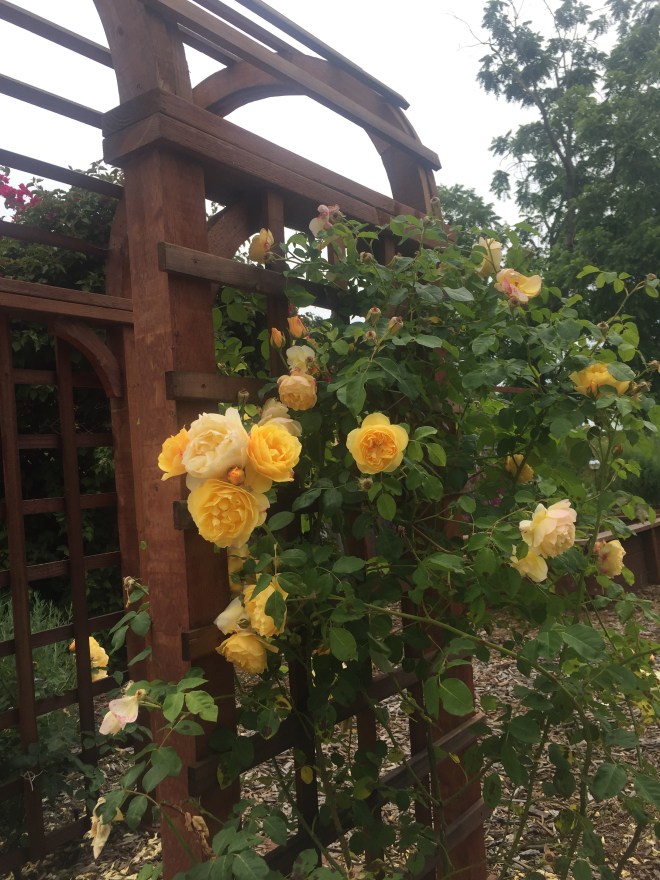
The Channel
Hidden in the hills,
a spring spills its secrets –
milk and honey from the womb of the earth.
Seeking its course through forest and vale,
water calls the banks of the river into being –
Find me!
Listen,
within you plays the song of the stream.
You are the banks of the river
and its bed
that give the water a place to go.
Unbraid your hair now, and
let the oncoming tide dissolve
your holding back.
Where the moon marries salt to sweet,
may your gathering waters
flow out to the sea.
Vernal Equinox
Before work I sit beside a pond
where frogs sleep and dragonflies play.
Winter is tipping into spring,
and already French lavender sends out faint tendrils of scent;
purple blossoms flutter up rosemary branches.
This is what we’ve been waiting for,
my hibernating muse and I.
Sun just peeking over a roof touches my forehead
and dapples the rust-red algae
covering the little pond like a velvet coat.
The monarchs are departing, winging their gentle way northward.
Now the sun kisses the page of my notebook,
and daffodils praise the morning light.
As Best I Can I Write Your Praises Down
Written December 29, 2015 at New Camaldoli Hermitage
It would be foolish to think that my humble Papermate pencil and I could offer up praise sufficient for the gifts of this morning. The waning gibbous moon was sailing into the west when I left my room, while in the east Venus glowed in the rose-rimmed azure sky that had already yielded her stars to the approaching dawn. In the chapel white-robed monks chanted ancient psalms by candlelight and sang of the old prophecy: “For us a child is born.” In the sanctuary bread was broken; together we ate, men and women, monastics vowed to this place and guests visiting from the world, together we drank from the common cup.
“Open your hearts to God’s tenderness,” the presider encouraged us in his thick Italian accent, he who dreamt during the night that an angel told him, “Keep it simple, Angelo. The more you speak, the less people hear.”
Let the garden outside my window speak, the bluejays and the little brown rabbit who come to breakfast here, the early narcissus blooming in the corner. The book of nature falls open to this spot on a mountain by the sea. Here in the day’s first rays of light is the praise sufficient to the gifts of this morning.
Title from a poem by 16th-century Italian poet Vittoria Colonna.
A Holy Fire
What if you were pregnant with a holy fire?
Would you be lit from within?
Might your warm skin and glowing eyes hint at the mystery to the outside world?
How would you nurture this fire?
When my friend was pregnant,
she gave up caffeine and alcohol,
ate fresh organic food,
and slept as much as she could.
She practiced breathing
to prepare for labor pains
and listened to beautiful music
so her babe’s delicate developing ears
would hear sweet sounds in the womb.
Rest your hand on your belly
as you long to gaze into the eyes
of the being within
and hold her in your arms.
Imagine the names that might suit her.
You are pregnant with a holy fire.
Purify yourself.
Rest.
Dream.
Now is the time of waiting,
now is the long night.
Breathe in
the darkness,
and breathe out
your fear.
You are tinder for the fire,
and it will burn in your bones.
The Gift of Tears
On a stormy night, rain drums on the giant bird of paradise outside my bedroom window, but it stands steady in the gale, for evolution designed ribs in its broad leaves: wind will split them rather than topple the plant. Before I knew this, the rips and fraying in the leaves seemed to mar the beauty of the garden, but now I understand them as its salvation.
So too do I understand the gift of tears. The sorrowing speak of heartbreak because that is how much loss hurts and how shocking the face of evil is to the good person, but red eyes and a salt-streaked face mean that the heart opened instead of breaking.
So take off your armor and lay down your sword, let the grief blow through you, for whether you be tender or hard of heart, the gift of tears will save you.