In a crazy, consumer culture that is busy bombarding us with demands and desires, how do we touch the peace that reigns in the cave of every heart?
Author: Mary Camille Thomas
Mary Camille Thomas is a native of Santa Cruz who is grateful to make her home on the California coast once more after living internationally and on the road. She studied comparative literature at UC Davis and received a master’s degree in library science from UCLA, which gave her a way to earn a living while making a life among books. Her poetry and essays have appeared in the Monk in the World Guest Post Series, Moving Force Journal, Presence, Porter Gulch Review, Second Wind, Sisters Singing, and The New Story, and she has completed a novel called What Lies Buried about a man reckoning with his family’s Nazi past.
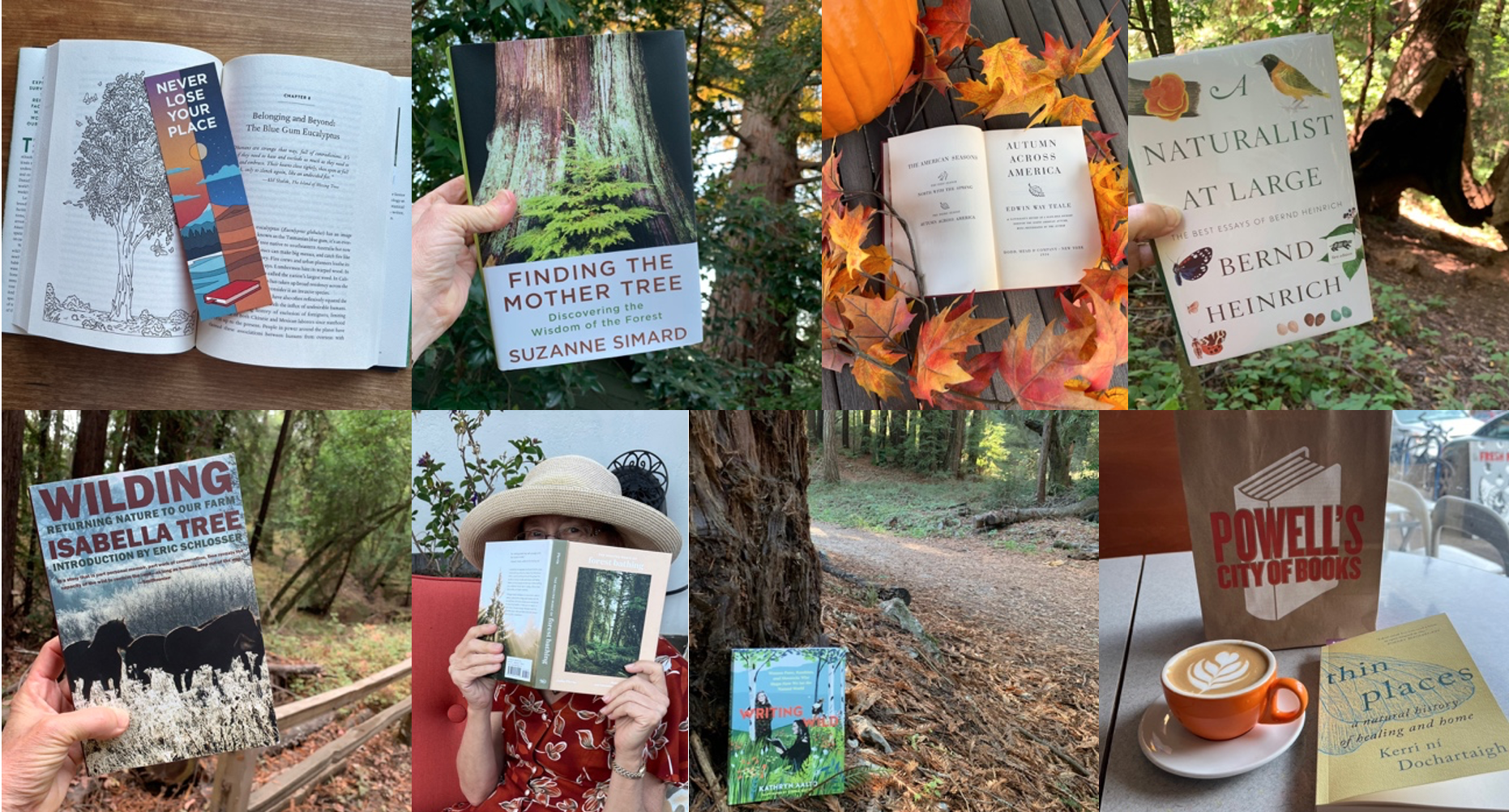
The narrator of Louise Erdrich’s novel The Sentence keeps a stack of Hard books and Lazy books by her bed. Unlike Tookie, I have only one pile somewhere in between. I learned long ago not to read a juicy novel right before bed at risk of staying up too late and being a zombie at work the next day, but in the vast realm of nonfiction it took me ages to discern what sort of books might soothe without being soporific. Philosophy is too demanding at the end of the day, politics and much history too potentially distressing; literary criticism put me to sleep too soon. Then The Hidden Life of Trees found its way onto my nightstand bookstack. The ways that trees communicate with each other are so fascinating I stayed awake till the end of each chapter and then drifted off to sleep with images of the forest in my mind. Nature writing turned out to be the ideal genre for my bedtime reading.
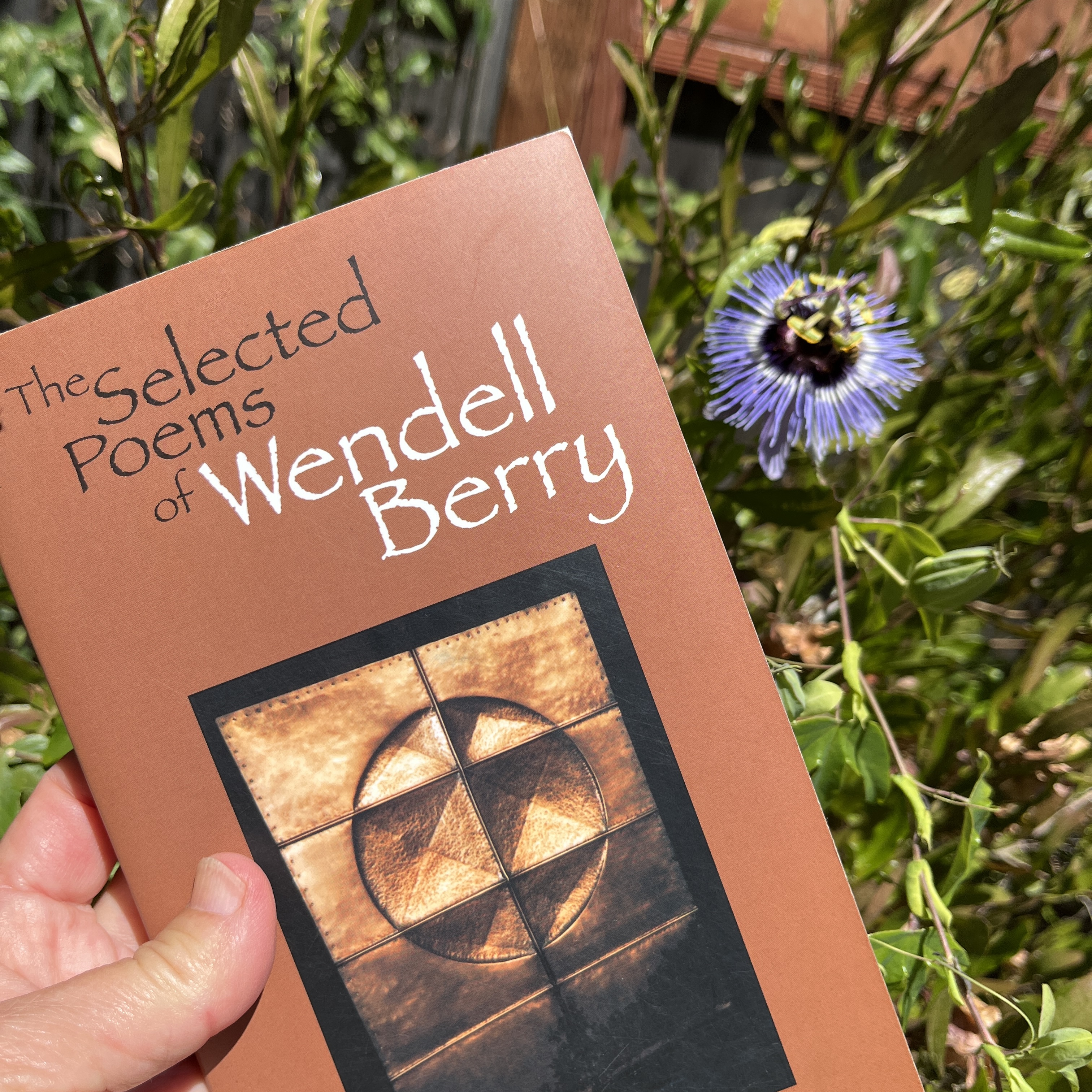
Imagine my dismay then when I learned that some critics consider nature writing a “bourgeois form of escapism.” In reply I could point to the solar panels on my roof and the electric car in my driveway to show that I’m not fiddling while Rome burns, but that might just seem like bourgeois environmentalist bragging. Still, the nature books I read before sleep are more than the literary equivalent of chamomile tea. They feed a soul that has found solace in the outdoors since childhood, a woman who hikes and gardens. From classics like A Sand County Almanac to contemporary essay collections like Helen Macdonald’s Vesper Flights, these books do more than put my mind at rest before bed. They stir in me a reverence for nature that plants me firmly on this earth and makes me want to protect it.
Nature writing also puts daily life and the very real woes of the world in a different perspective. Though not a replacement for being outdoors, it helps me feel connected to something larger than myself, a web of life in which I have a home – and at the end of the day a place to rest.
What does it mean for me to be an American patriot when the President of the United States announces that he hates me? (Or at least hates the people I voted for?) I used to mistake patriotism for the pure pride I felt as a kid in 1976, sporting red, white, and blue bell bottoms and waving a flag at the 4th of July parade. The bicentennial was also the year I memorized the preamble to the Declaration of Independence and still took for granted my right to life, liberty, and the pursuit of happiness, when I still believed the flag really did stand for a nation with liberty and justice for all. But patriotism, I have come to realize, is more than a swell of emotion.
The reason the President gave for hating Democrats was that we hate America, but he’s wrong about that. I love this country: its natural beauty, the diversity and energy of my fellow citizens, our long history of fighting for freedom. (Though not exclusively) I love American food, music, movies, and literature, and to this day a unique rush still sweeps through me in that moment before a baseball game when I stand and doff my cap for “The Star Spangled Banner.” As with any friend, however, I acknowledge this country’s shadow while also honoring what I love about it.
Our original sins of genocide and slavery, largely unconfessed and yet to be redeemed, cast a long shadow indeed, dark not just with the anguish and fury of the aggrieved but also the defensive entrenchment of those who want to believe no harm was done, want to believe that soldiers who massacred Lakota people at Wounded Knee deserve Medals of Honor and that a photo depicting an enslaved man’s scars should be removed from the Smithsonian because it reflects “corrosive ideology.” Yet even as I shiver in this shadow and wonder about reparations, the stain of our sins doesn’t erase all that I admire about my country. I love that our crown jewels aren’t displayed in a tower or museum. They are the national parks open to all, our civil rights guaranteed in the Constitution. Is it a stretch to say that in acknowledging the worth and dignity of the human person, the Bill of Rights is a formal, political way of expanding the golden rule, that fundamental guideline most of us learned in kindergarten? Found across world religions, in the Christian tradition it’s part of Jesus’s Sermon on the Mount: do to others as you would have them do to you.
My first promise to myself after the 2024 election was to be a citizen witness – to pay attention to what is happening even when it makes me weep or terrifies or outrages me. Like a nuclear technician with a Geiger counter, I exercise cautious discipline in my news consumption and try to set aside the newspaper or podcast before the tidings reach toxic levels. Likewise social media: I haven’t blocked the friends who disagree with me, but I am strict about checking each platform no more than once a day. Even this level of witnessing exacts a cost, no doubt familiar to you, dear reader: not just an emotional toll but also moral injury. To replenish my reservoir, I fill it with the antidotes I wrote about in “Coping with Chaos and Calamity:” perspective, nature, community, and joy in the everyday pleasures that come my way.
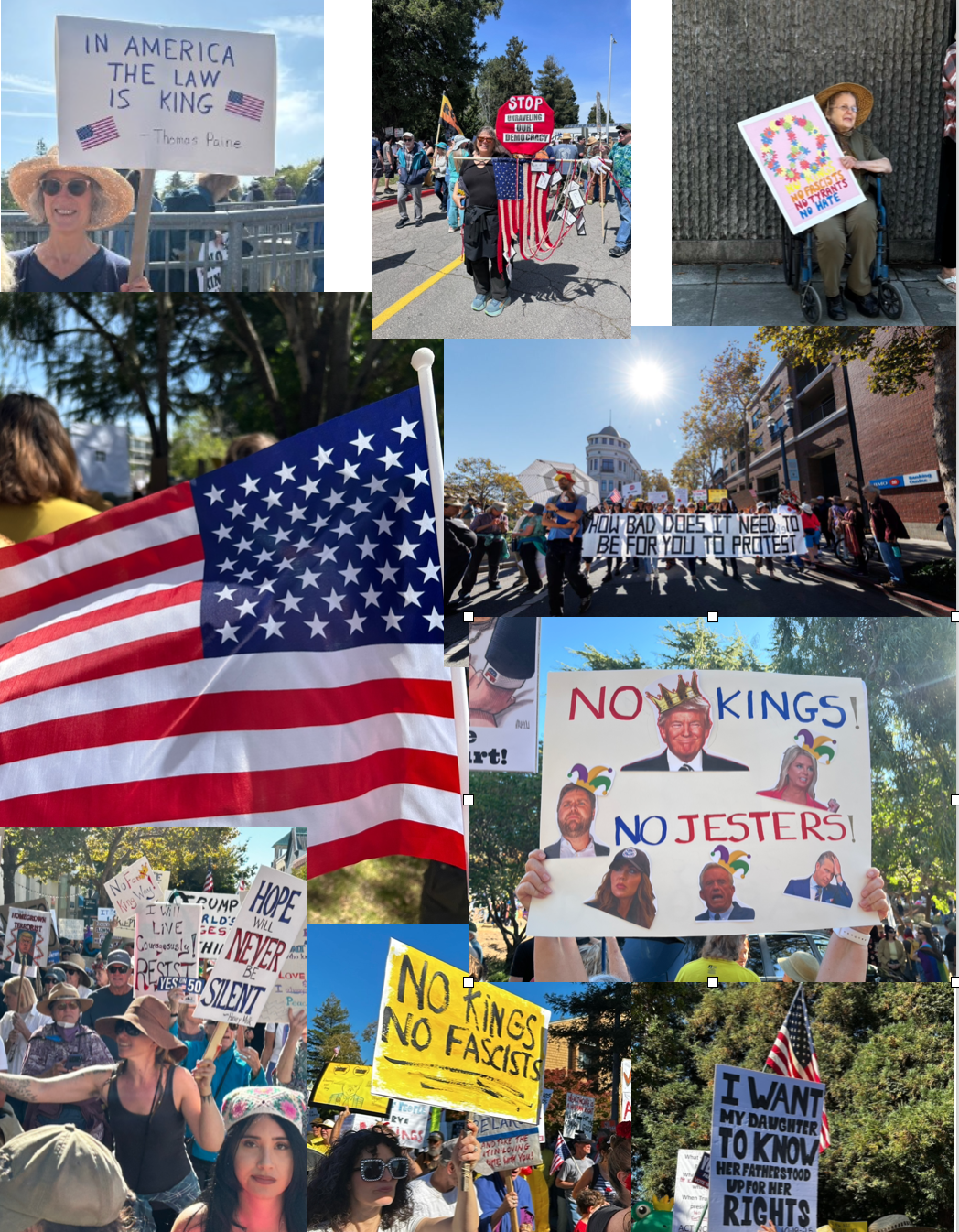
My commitment to be a citizen witness is moving me towards patriotism as a practice rather than a feeling. In hindsight, the first and maybe most important responsibility of a patriot I’ve actually been fulfilling since I was 18: voting. Other steps folded into the routine of my daily life: obeying the law, paying taxes, teaching college students how to find and evaluate information, trying to love others as myself. This year of broken promises and disregard for the Constitution has demanded more action. Along with millions of my fellow citizens, it has called me to the public square in nonviolent protest. The people I march with, friends but mostly strangers, come from various faiths or no faith at all. Our sundry signs carry different slogans but have a common theme: dismay at repeated and callous violations of the golden rule.
Lately I’ve been noticing more US flags at protests. Some are upside down, a traditional signal of distress, and many are right side up, a sign of patriotism and a reminder that the flag doesn’t belong to MAGA any more than the cross does. I have never loved my country more than I do now that I see a democracy I took for granted slipping away. Maybe part of growing my patriotism is reclaiming the cross and the flag.
When I looked up the symbolism of the Stars and Stripes, I found this quote from Ronald Reagan: “The colors of our flag signify the qualities of the human spirit we Americans cherish. Red for courage and readiness to sacrifice; white for pure intentions and high ideals; and blue for vigilance and justice.” I don’t know yet how much courage I will need or what sacrifices I might have to make, but my intentions are pure. The qualities President Reagan mentioned are the values I want to carry with me in my determination to honor and defend what I love about my country.
For many years now I have become increasingly reluctant to wear a cross necklace in public, not because I am ashamed of my Christian faith but because I’m afraid it will mark me as something I am not –- one of those people, as David Brooks put it, who “have crosses on their chest but Nietzsche in their heart—or, to be more precise, a high-school sophomore’s version of Nietzsche.”
Today, September 14th, the Catholic Church (along with Anglican and Eastern Orthodox Churches, I learned from Wikipedia) celebrates the Exaltation of the Holy Cross, a special feast day for my home parish of Holy Cross in Santa Cruz, California. My non-Christian friends may find it strange to exalt what they see as an instrument of torture and death, and I can’t blame them. In the Roman Empire crucifixion was a brutal method of execution meant to instill fear, and the cross was a symbol of their power. But for early Christians it came to represent the great love story that was the origin of the Church: the love of Jesus who laid down His life for his friends.
No one has greater love than this, to lay down one’s life for one’s friends. – Jesus (John 15:13)
To say that the cross symbolizes love might seem simplistic and vague, so I’m turning to Jesus’s own words for insight on how to be a little more specific. When I read the Gospel, it seems that for Jesus, love meant solidarity with the poor in spirit and pure of heart, with the meek and merciful, and with peacemakers (Matthew 5: 1-12). He asked his followers to feed the hungry, clothe the naked, and look after the sick, even to invite the stranger in and visit those in prison (Matthew 25: 34).
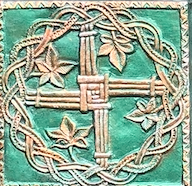
I confess to you, dear reader, that I am far from living up to this call, but that’s what I aspire to. If you notice the Brigid cross in my garden or see me wearing one around my neck, please know that it’s not a political statement. It simply means that I am choosing love over fear.
Once a year, midwinter, a question starts percolating in my mind: what should I give up for Lent? These days I also wonder how to steady myself as a citizen witness in a time of chaos and discord when men in power willfully inflict suffering. On Ash Wednesday my answer boiled down to resistance. Instead of fasting from candy or alcohol, I stopped shopping at Amazon and withdrew from Facebook and Instagram.
Will my individual action make a difference? Honestly, no. Boycotting companies owned by oligarchs can’t be effective unless some critical mass of consumers join in and sustain the embargo for as long as it might take – like the bus boycott or the UFW grape boycott. And would scaling up be a fair ask? Lots of people rely on Meta platforms to promote their businesses, and online shopping is a lifeline for the homebound — not to mention all the employees who depend on these companies for an income. Lent has made me realize how lucky I am. Shopping local and taking a break from social media for forty days haven’t turned out to be much of a sacrifice.
The forty days before Easter are not just about giving something up though. Fasting is meant to be joined with prayer and almsgiving, an intertwining of traditional practices that braid action and contemplation. This Lent has brought me new prayers: a friend taught me to chant the Mangala mantra, which includes the plea, May the leaders of the earth protect in every way by keeping to the right path,* and Abbey of the Arts introduced me to earth psalms. Meanwhile, an old prayer has become more heartfelt: deliver us from evil. To whom shall I give alms? I have only to pose the question for answers to come. Last week I got an email from Second Harvest Food Bank asking for help as they try to “overcome the challenges created by recent shifts in U.S. policy, including federal funding freezes that have disrupted our food supply.”
With its threefold practice of fasting, prayer and almsgiving Lent has given me hints for how to be a good citizen. The personal is political, and, as it turns out, the spiritual is too.
* Translation from Sri K. Pattabhi Jois, Yoga Shala Nashville. I’ve also heard this translated May the citizens, lawmakers, and rulers walk the right path.
Amidst last winter’s lettuce, henbit deadnettle flaunts
small purple velvet blooms
unfurling
yet smaller
speckled petals.
The beauty of what I call weeds
startles me into gratitude,
and I sing praise to the earth.
I name you, holy uninvited —
nettle and broom,
thistle and vinca –
and bow before your tenacious ingenuity,
for you glorify the Author of Life
in your surging greenness.
When I looked out my window,
you showed me your loveliness;
your bounty reminded me of our plenty.
All the fearful would surely recognize abundance
if they could see the unstoppable
flowering in this garden,
if they only breathed in the aromas of
sweet peas and angel’s trumpet.
Though the Beloved dwells in paradise,
She cares for the nettle and broom
as much as the jasmine and rose;
both planted and uninvited
are holy in Her sight.
Though I fear scarcity,
you fill this plot with hurtling life.
You offer enough to feed us all,
more than enough to save us.
The earth will make good her purpose for me;
O Sacred Earth, your greening endures forever;
do not abandon the fruits of your flowering.
Audio version of The Holy Uninvited
A note about this poem: In January I started reading the book Understorey: A Year Among Weeds by Anna Chapman Parker, and it inspired me to pay attention to the weeds in my garden. Although oxalis dominates with its neon yellow flowers, when I set out to explore the verdant greenery currently burgeoning in my backyard, I identified twenty other species— many of which I would have considered wildflowers if I’d discovered them on a hike. And now that I know another name for oxalis is Bermuda buttercup, how could I not want to make peace with it?
Then last week, for an online retreat through Abbey of the Arts called Earth Psalter: Writing Psalms for the Anthropocene, I was asked to “bring an object from an outdoor place that is meaningful to your experience of your ecosystem.” Minutes before I was supposed to show up on Zoom, I raced out to the still dewy backyard with my clippers and put together a small bouquet of weeds/wildflowers that inspired this song of praise and gratitude.
Thank you to Abbey of the Arts for this new approach to the psalms!
Some days it seems the only happiness to be found is in the elusive oblivion of sleep. On those days the price for staying awake is high, tears the only outlet for a toxic broth of fear and rage against disaster I’m too small to change. When I feel like my kayak has capsized in the rapids, I try to return to the ritual of lighting a candle to Brigit, a ritual that symbolizes and feeds my faith in the light — that Great Love that kindled my inner flame, that light that can overcome any darkness. Then I’m a little better able to see difficult feelings as potential tools for survival: fear warns of danger, anger powers action, tears are a vital expression of sorrow. To balance and bear these emotions I’ve learned some coping strategies from friends over the last few months that help me access the light and nurture my inner flame.
1. Keep things in perspective.
The sweep of history is long, holding meteor strikes and ice ages, the rise and fall of civilizations, cities destroyed and rebuilt. Positioning the current calamity on that long arc lets you view it in a different way — it may be overwhelming now, but it won’t always be. In my late thirties infertility and divorce seemed like the defining events of my story. Now at age 63 they are simply chapters in a much longer book. If this is the case with a lifetime, it is even more so for a country. In just 250 years the United States has witnessed a successful fight for independence from empire and civil war; Americans saw the excess of the Gilded Age give way to the corrections of the New Deal.
To be clear, the suggestion to keep things in perspective comes with a few caveats. For one thing it can feel limited to the privileged. Perspective might not be available to me if my home had been bombed or burned, if I had just lost my job or feared being deported. Nor should it provide false comfort that things aren’t really that bad. “Pay attention” was Mary Oliver’s first instruction for living a life, which means noticing goodness and beauty but also recognizing tragedy and treachery. Perspective doesn’t minimize calamity, it places this knot of suffering in a larger tapestry. Yes, what is happening now is unprecedented, but as a friend told me recently, we’ve been here before, and we know what to do.
2. Seek sustenance in nature.
My favorite tree when I was growing up was the pine in our backyard. In my essay “The Secret Forest” I describe it as “a bit of the wild in our tract house neighborhood where my sisters and I could climb, build a clubhouse, or imagine elves and fairies. The green needle canopy of that single pine, its sappy branches, duff carpet, and unique scent formed an entire arboreal world, Sherwood, Narnia, Fangorn Forest. And when I tired of company and play, it became a place to hide out, just the pine tree and me, my first hermitage.” Even as a child I understood the solace to be found in nature.
Now more than ever, go outdoors and open your senses wide. Try closing your eyes. What do you hear? Smell? Take off your shoes and find a place to plant your bare feet. As I write, I’m imagining the sensation on my soles of hard-packed sand, cushiony grass, moist and loamy garden soil. Walk among the trees. Press your forehead to the trunk of the redwood and lay yourself down in her duff. If you don’t have a place nearby to forest bathe, look up. On busy days, I like to take what I call “sky breaks” to savor for a moment whatever that immensity above me has to show.
3. Lean into community.
Even an introvert like me needs community. Now is the time to seek deeper connection with yours. Another caveat: social media might not be the best way. Instead gather with friends, go to church, play pickleball. I see people around me engaging in all kinds of ways: singing in a choir, taking a dance class, volunteering, joining a protest. Does all that sound ridiculously beyond what you have the capacity for right now? Text a friend and ask her to light a candle for you. (Or email me, my candle is ready.) Next week you might have the energy to meet for coffee.
4. Find joy in the ordinary.
For several months last year, caring for my aging parents meant spending more time than I ever had before in the emergency room and ICU. My sisters and I were inundated dealing with doctors, insurance companies, and attorneys, trying to arrange at-home care and then assisted living, reacting to one crisis after another. In the midst of this, my mother shared advice that her spiritual director had given her when Mom was caring for my grandmother. You might expect a nun to encourage you to honor your parents or pray the rosary, but that was not this sister’s approach. Instead, she advised my mom each and every day to look for joy.
When I tried it, I had the same experience Ross Gay did when he started writing an essay everyday about something delightful. He discovered “that the discipline or practice of writing these essays occasioned a kind of delight radar. Or maybe it was more like the development of a delight muscle. … Which is to say, I felt my life to be more full of delight. Not without sorrow or fear or pain or loss. But more full of delight.” Now the same thing happened to me: I developed a joy radar. A perfect feather from a hawk on the wing floated down into a crosswalk just as I was about to step off the curb. A friend’s baby granddaughter flashed me a bubbly smile. Soon my sisters and I were texting each other our daily joy, multiplying the effect.
***
As I struggle for equanimity, I find encouragement in a letter written almost two thousand years ago: “Let us lay aside the deeds of darkness and put on the armor of light.” This was St. Paul to the early Christians in Rome, and by light he meant love. Why then does he choose such a martial metaphor? I personally would rather draw a cloak of kindness around me than put on a suit of armor. But choosing love in challenging times takes great courage and fortitude, and I want to feel protected when I go out into the world, not by weapons, not by metal, but by light — the great love that kindled my inner flame.
Nature, community, joy — it may sound corny, but these are rays of light, and you can probably see how they feed each other. Moments of joy are highly likely when you’re stargazing or line dancing at the community center. In the life of a redwood this moment is a blip, and connecting with the world beyond your immediate crisis can shift your perspective.
Darkness does not have the last say. No matter what happens you are held in the great web of life.