“I can hardly wait to have a drink,” a fellow churchgoer told me with a grin as we walked out of the Easter Vigil a few years ago. Ah yes, the bliss when you finally partake of a delight you’ve abstained from for forty days. (Alcochol! Chocolate!) But that was the year I gave up social media, and I had no burning desire to rush home and check Facebook. In a relatively short time I’d gotten out of the habit of even thinking about it. Plastic, on the other hand, I have obsessed about like no other Lenten sacrifice of my life, yet there can be no blissful anticipation at returning to its use.
“How’s your plastic challenge going?” friends often asked me over the last six weeks, and the answer was always some variation of humbling – because I kept failing. Early on I imposed my own penance and promised to give 50¢ to charity for every piece of plastic I put in a trashcan and 25¢ for every piece I recycled. Any guesses on my donation to Save Our Shores? My transgressions add up to a shocking $25! The biggest culprits were trash bags, tamper-proof seals, and takeout containers. There’s not much I can do about those plastic seals, but I’m learning which restaurants use compostable containers and try to remember to take my own “doggie bag” with me when I go out for a meal. Despite my failure to completely eliminate single-use plastics, I have reduced, which means less garbage and fewer trash bags. If you’re contemplating reducing your plastic use, consider other side benefits. Eating less processed food is good for your body as well as the planet. By not shopping online, you will support local businesses and maybe even buy less stuff.
Which habits will stick now that Lent is over? To be honest, the ones that don’t require much of a sacrifice like using mesh produce bags and shopping bulk bins. Avoiding clamshell containers is much harder because I love fresh berries and those Trader Joe’s salads that are perfect to take for lunch at work, but I’m going to try. I’ll definitely keep relying on my Kleen Kanteen and Zojirushi coffee cup and plan to switch from liquid to bar soap, but I might not keep making my own yogurt. (At least yogurt tubs can be recycled though.)
After forty days of considering environmental action as spiritual practice, I’m delighted that Easter and Earth Day almost coincide this year. At this double celebration of life and hope, I’d like to end with a poem in honor of the gray whale I wrote about last week.
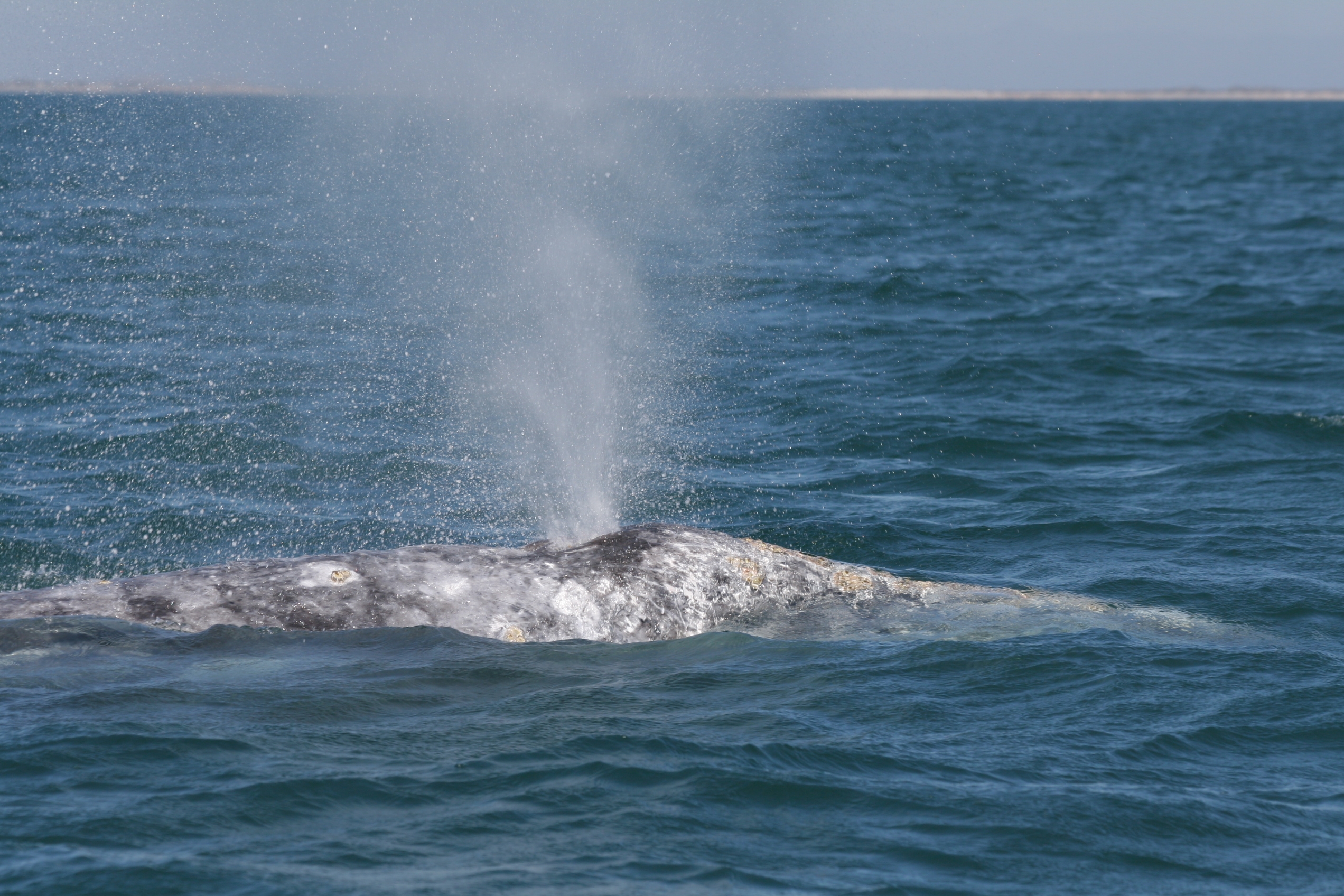
In 1995 I was traveling down the length of Baja in a 26-foot motorhome with my ex-husband. In the village of San Ignacio we heard tell of a lagoon many miles down a dirt track where gray whales came every year to mate and bear their young. Although it was late in the season, well into April, we signed up for a tour. A fisherman who spoke only Spanish drove us in an old pick-up down the long bumpy road to Laguna San Ignacio and helped us aboard his little panga. It was just Marcus and me and the fisherman, and we motored out into the lagoon.
We soon spotted dolphins leaping in buoyant, graceful arcs out of the water, but most of the whales had already headed north. When we finally came upon a mother/baby pair, the few other boats carrying tourists zeroed in on the same spot. Later I would learn that the lagoon is a sanctuary and that there are rules about approaching whales there – you’re not allowed to, must wait for them to come to you – but on this day there was a dearth of whales, so the boats with Norteamericano tourists to please swooped in on the pair and followed them. Very soon, though, Marcus and I asked our boatman to abandon the chase; we didn’t have the heart for it.
Back on shore, the fisherman’s wife cooked us a lunch of deep-fried fish and beans and tortillas. While we ate with the family in their small hut near the sea, they showed us photos to prove the stories they’d told of friendly whales, pictures of people leaning over the sides of pangas to pet whales that swam right up to the little boat. You had to come earlier in the year, we were told; by now most had departed the lagoon for their long migration up the Pacific coast to Alaska.
Two years later Marcus and I returned to Baja, in March this time, and made a beeline down to San Ignacio. The village was as we remembered –women patting out the most delicious tortillas in the world at the same little tortilleriaand children selling dates underneath the oasis palms shading the village square. We drove our motorhome down the long dirt road and slept on the shore of the lagoon where the sounds of whale spouts floated out to us on the sea breeze. “I can hear Whale breathing,” I said.
We had arrived at the height of the season, and when the wind died down the next morning, we joined seven other people in a panga. This year there was no skulking about in sly pursuit. Before long a mother and baby swam up to us. The fisherman cut the engine, and the mama sidled next to the boat. We stretched out our hands to touch her back, covered with barnacles, and I marveled. In a place where my kind had once hunted her kind, a wild sea creature weighing ten tons was choosing to visit us, not coerced nor tempted by food, but choosing of her own free will. What could her reason have been? Curiosity? The allure of connection? I only know that after a while she dove back underwater and nudged her baby up to the surface for the same attention, as if saying, there are some interesting little creatures up there. Go on, check them out.
I treasure this photo of the mother whale and me in Laguna San Ignacio and the memory of that contact with a magnificent creature from another realm. She could easily have tipped our boat over, but she was polite and gentle – unlike the humans in the boat. In that profound moment the panga almost did capsize as we all strained over the edge of the boat at the same time, fighting for the prize of having our picture taken with a whale.
I thought about that moment when I heard last month about a Cuvier’s beaked whale that washed up on shore in the Philippines. It was not a diseased or shark-bitten carcass, but a young animal that had starved to death – from eating plastic.
More than eighty pounds of plastic bags, rice sacks, and other garbage in its stomach made it feel so full it stopped eating. “It’s disgusting,” the biologist who conducted the necropsy said. This story made the international news, but like the human calamities that fill our headlines, it is not uncommon. In Thailand alone 300 marine mammals die each year from ingesting plastic. For those of us who eat seafood (with apologies to my vegetarian friends), it doesn’t take a marine biologist to figure out where microplastics in the ocean food chain end up.
“But the plastic I throw away or recycle doesn’t end up in the ocean, does it?” a friend asked me recently. “No, no,” I assured her, but privately I wondered, where does all the plastic swirling around the Pacific Gyre come from? Cruise ships maybe? Or countries that can’t afford to recycle? Surely not from my eco-conscious town!
My guesses were not far off. A recent report by Ocean Conservancy and the McKinsey Center for Business and Environment found that 20 percent of ocean plastic debris “originates from ocean-based sources like fisheries and fishing vessels.” The rest comes from land-based sources, and over half of that comes from “just five countries: China, Indonesia, the Philippines, Thailand, and Vietnam … These countries … are at a stage of economic growth in which consumer demand for safe and disposable products is growing much more rapidly than local waste-management infrastructure.”
In my part of the world this infrastructure is robust, and like me you have probably been dutifully recycling for decades. In the last year, though, I’ve learned that there are limits to what plastic can be tossed in the blue recycle bin. What exactly these limits are was a little vague for me, but after just watching the YouTube video Recycle Right! Santa Cruz, I’m starting to get a handle on it. First, everything must be clean. “Stretchy” plastic (e.g. produce bags, plastic wrap, bubble wrap) is okay if bagged and so are most containers (jars, bottles, jugs, and tubs), but “crinkly” plastic (e.g. potato chip bags), hinged food containers, plastic containers that can’t be cleaned (think lotion tubes or motor oil jugs), and other items like hangers, toys, buckets and nursery pots belong in the trash. To make matters even more complicated, every community has different rules, so check with your local waste management to know for certain what you can put in your blue bin.
Where does all this plastic end up? “For the past three decades, almost half of the entire world’s used plastic has been sent to China,” where small factories employing cheap labor converted it into “inexpensive, plastic exports like shoes, bottles, hoses, and gadgets,” but suddenly the Chinese don’t want our garbage any more. They are turning to more lucrative industries like tech, plus they want to cut down on the pollution that came with all that plastic. The New York Times reports that “While there remains a viable market in the United States for scrap like soda bottles and cardboard, it is not large enough to soak up all of the plastics and paper that Americans try to recycle.” American cities (and airports and parks) are scrambling to figure out what to do.
Does this mean we should quit recycling? Definitely not! Technology may make it feasible to burn recyclables and convert them into energy, or recycling may simply become more expensive. There are options and possibilities, but as Lent began last month, the news stories about the dead whale in the Philippines and about China stopping the import of trash had one thing in common: we must rethink our use of plastic.
Change has to occur at the global level, but it starts with individuals, you and I taking our reusable shopping bags to the grocery store and drinking water from our refillable bottles. Locally it heartens me that students at Foothill College drove the change to equip water fountains with bottle filling stations and that more and more restaurants are using compostable takeout containers and utensils.
And even at the global level change is possible. Gray whales were hunted almost to extinction, but by 1994 the population had recovered enough that they were removed from the endangered species list, and in Laguna San Ignacio these giant, gentle creatures make friends with humans. In a place where harpoons once flew, a mother who would have been prey let me pat her back and watch her baby play.
What do a carton of Ben & Jerry’s, a greeting card, and a pack of chewing gum have in common? I wish I had a funny punch line in response, but I don’t. These three objects are simply the sacrifices I didn’t anticipate when I decided to give up single-use plastic for Lent. Today is Laetare Sunday, taken from the Latin word for “rejoice” in the entrance antiphon at today’s Mass, and we are halfway through Lent, a good time for me to take stock of my plastic challenge.
Because I’d considered this for a year, I really thought I was prepared. I had braced myself for forty days of no online shopping, knew I would have to give up flower bouquets and salads from Trader Joe’s, but the first week of Lent I bought ice cream to go with the brownies I was baking for company and didn’t notice until I opened the carton that the lid was covered with a plastic seal. A package of gum was likewise wrapped in cellophane. Later in the week when I reached into my desk drawer for one of the birthday cards I keep there, I was horrified to realize that most of them are covered in protective plastic! How had I not noticed it before?
My response to these surprises offer two options for reducing plastic use. One is to look for workarounds. For example, in Santa Cruz I can buy hand-packed pints at Marianne’s or Penny Ice Creamery, and it’s possible to find plastic-free greeting cards; I just have to be mindful about selecting them. The second option is less appealing, to do without, and that’s what I’m trying with gum. The third option is to admit defeat, and now it’s time for a confession.
When I planned for this challenge, I was relieved that my most cherished food group would not be a problem. Alter Eco chocolate bars are wrapped in foil and packaged in cardboard with the motto “enlightened indulgence,” and Dagoba cocoa, the key ingredient in my morning mocha, comes in a can. Phew. Except that like Ben & Jerry’s, that can has a tamper-proof seal. Sigh. I can and do rationalize that the piece of plastic is small and that a single can of cocoa makes about twenty servings, but it is, in fact, only one in a category of items I can’t find a hack for and am not willing to give up. Sometimes, even when I’m trying to do the right thing, I can get in trouble. Last week I contributed compostable plates, cups, and utensils for a party at work, but guess what the plates and cups were packaged in?
To compensate I have imposed my own penance. In the Lenten spirit of almsgiving, I plan to donate 50¢ to charity for every piece of plastic I put in a trashcan and 25¢ for every piece that goes in the recycling. This also helps me account for plastic I acquired before Lent and am using now.
To be fair, I also want to congratulate myself and the friends who have joined me for what we are attempting. The plastic we’re not using is invisible, but it makes a difference.
It’s hard! I confess, dear reader, that right off the bat, on just the second day of Lent, I blew it. A friend and I went out for dinner at an Italian restaurant in Monterey, and neither of us finished our meal. Not wanting to waste food (that’s virtuous, right?) we accepted the waiter’s offer to box our leftovers. But before I knew it, two large plastic bags appeared on the table.
At least the bags were “made with Post Industrial Recycled (PIR) materials and contain environmentally friendly EPI Bio-Film additives.” As encouragement, they have the words “Reusable Bag” printed in large letters across the center. If my goal is to reduce single-use plastics, I could meet it by using this as a garbage bag, but realistically, what else would I do with it? So should I have taken the food boxes out and returned the bags to the waiter? But once they’d been used, could the restaurant give them to another customer? And what about those boxes? They were cardboard, not plastic or Styrofoam, but they have a waxy coating to prevent moisture seeping through, and guess what it’s made of? More on this later, but hint: it’s not wax. (Note: I did save my bag for reuse!)
Over the last year, ever since I read about the Church of England’s Lenten challenge to give up single-use plastics, I’ve become more diligent about taking my reusable mugs, bottles, and bags with me wherever I go. I even gave my sweetheart a Soda Stream for his birthday, so we could enjoy sparkling water without having to buy and recycle bottles. As this Lent approached, though, the hard reality of life without plastic began to set in.
Text from my sister
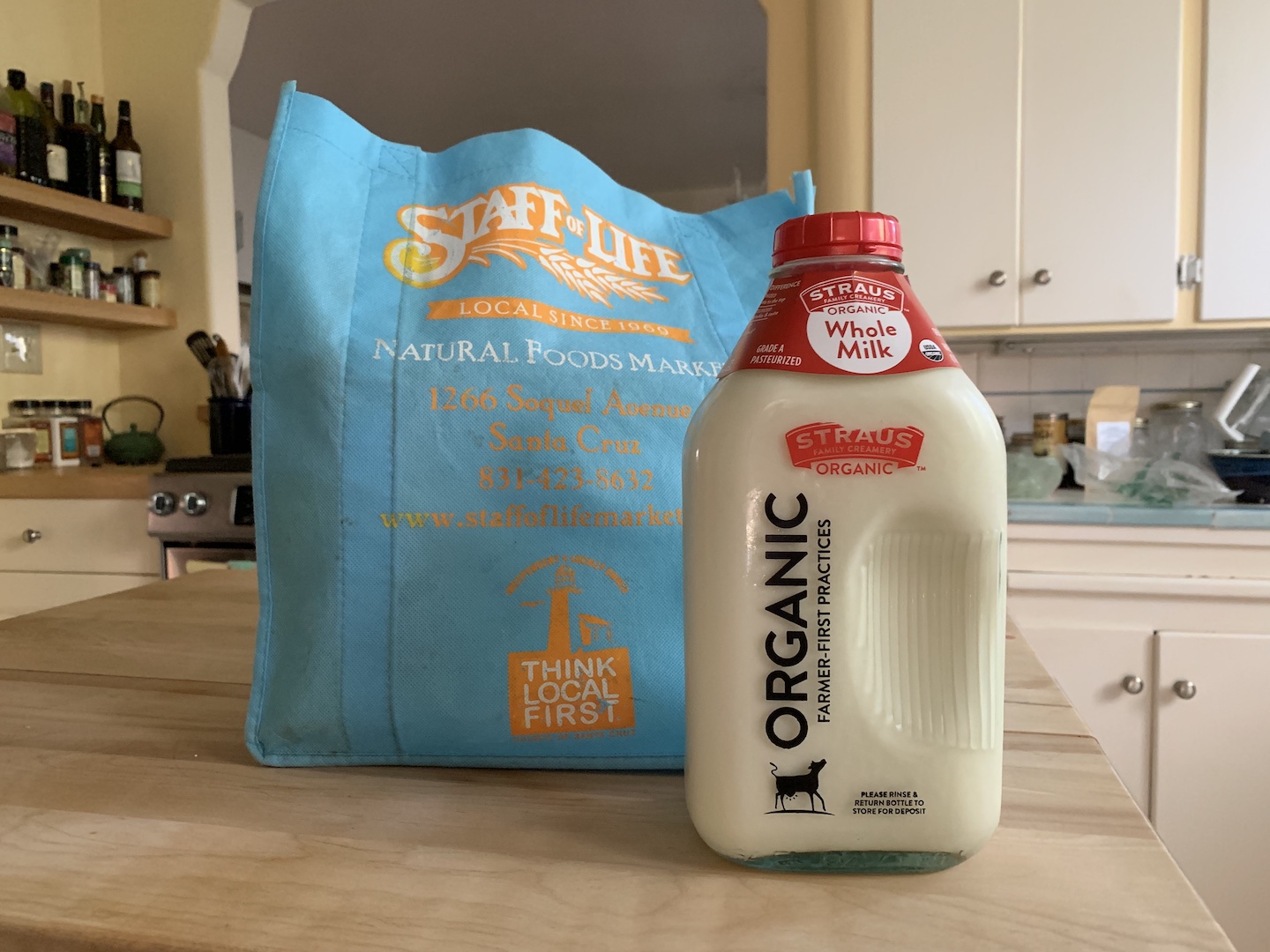
I didn’t roll around in bubble wrap on Fat Tuesday, but in the last few weeks before Ash Wednesday, I savored fresh grapes and started to practice by giving up pre-packaged salads from Trader Joe’s and instant oatmeal cups while I contemplated the other conveniences soon to disappear from my kitchen: pre-made pie dough, microwave popcorn, Amy’s frozen pot pies … With suggestions from my sisters, I bought re-usable mesh bags for produce and learned how to make my own yogurt. Yogurt making presented a dilemma, though. The recipe calls for a half gallon of milk, but remember that waxy coating I mentioned earlier? Like the takeout boxes at the restaurant, milk cartons are coated with polyethylene. So I found milk in a glass bottle that I could return to the store, but guess what it’s sealed with? A plastic cap!
Plastic is pervasive, but the good news is that positive changes are already entering our culture. Witness the ubiquitous Kleen Kanteen, Hydro Flask, and Contigo coffee mug. At Foothill College, where I’m a librarian, drinking fountains are equipped with bottle filling stations, and the coffee kiosks and cafeteria stopped selling bottled water two years ago. (Students, by the way drove this change!) Many California cities, including Santa Cruz, have banned Styrofoam from food service and require that all food takeout containers be compostable or recyclable. In response to a Greenpeace petition, Trader Joe’s is phasing out single-use plastics. Will Field Fresh Chopped Salad with Grilled Chicken return to my lunch bag one day?
Water fountain on West Cliff Drive
Wondering how you can join this bandwagon? Reduce, reuse, recyle is the mantra here. With appreciation to the Church of England, here are some specific tips:
Treat yourself to a travel mug and a water bottle. (Then remember to take them with you!) Bonus points if you also get a metal or bamboo straw.
Bring your own shopping bags, and consider buying reusable mesh bags for produce.
Shop at the farmer’s market.
Get acquainted with the bulk bins at your health food store.
Avoid processed foods.
Join a local food co-op or CSA (community supported agriculture). In Santa Cruz, the Live Earth Farm CSA uses no plastic in their weekly boxes of fresh organic produce.
Rinse and re-use ziplock bags.
Planning a picnic, party, or potluck? Consider compostable plates and utensils. Bonus points, though, if you can figure out a way to use real dishes!
Of course, only consider practices that you can afford and have time for. Dwelling in the Kingdom of Enough means caring for our common home, but also living your life in a way that’s sustainable for you.
To circle back to the story at the beginning, picture me at an elegant restaurant on Cannery Row. Would it be embarrassing to pull a reusable plastic container out of my purse when the waiter asks if he can box my leftovers? What do you think? When it comes to food and drink in general, how do you avoid single-use plastics? Please comment!
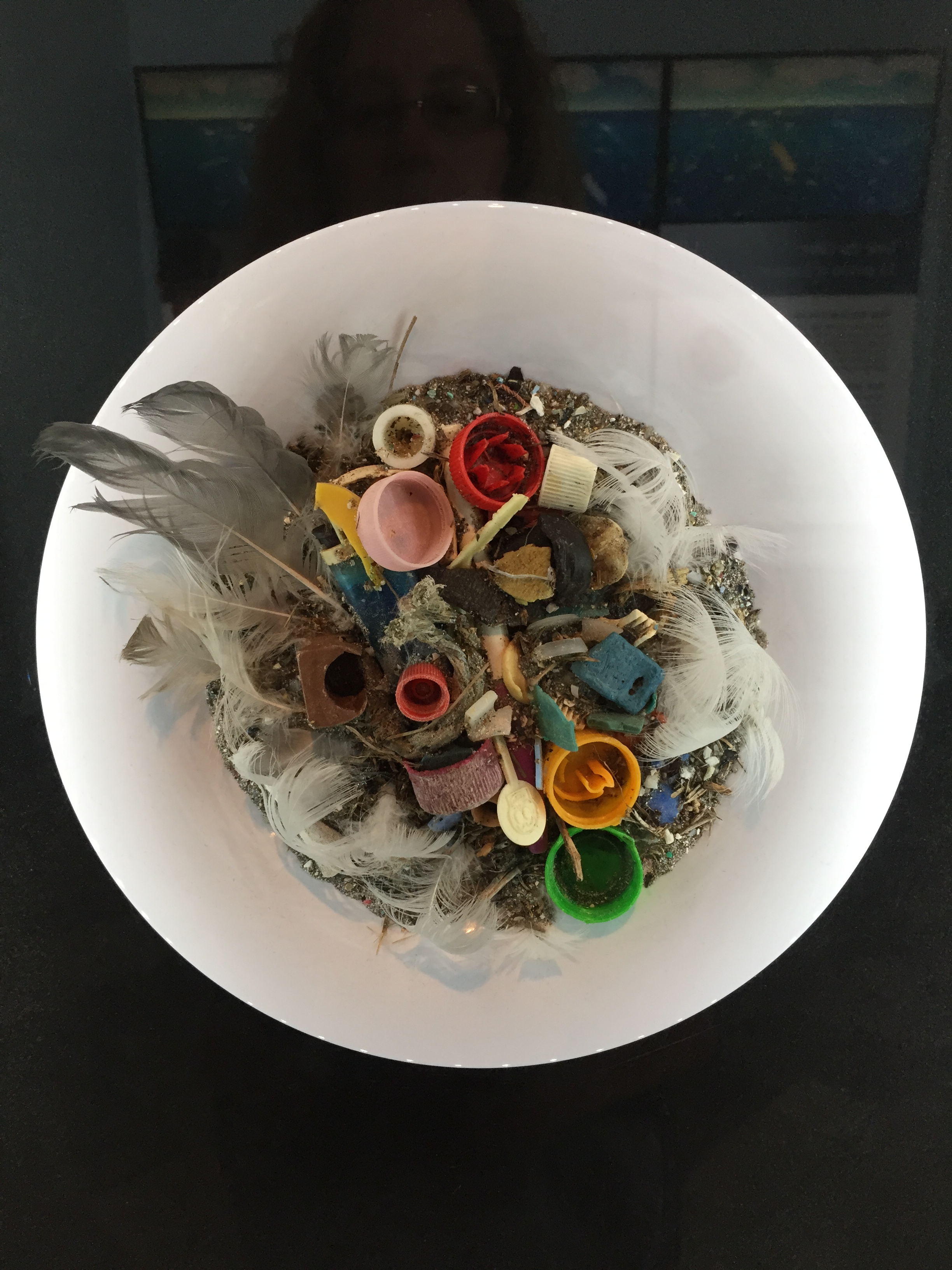
Would you ever knowingly swallow plastic? Yet the North Pacific Gyre is swirling with plastic from all over the globe, a garbage patch three times the size of France. Fish and birds ingest it, and so, eventually, do we. Off the Carmel coast the sea floor is white, thick with thousands of golf balls.
These plastic pieces were found in the stomach of a Laysan albatross chick on Midway Island. From an exhibit at the Monterey Bay Aquarium.
When I was a girl, Aunt Ellen’s blueberry muffins were a special treat. Now blueberries are a year-round staple in my diet, piled on top of yogurt or nibbled mindlessly as a midmorning snack. So healthy, so delicious! But whether organic or conventional, sold in plastic.
My neighbor Dick jokes that if you walk down the street in Santa Cruz, you must be accompanied by a dog on leash, talking on the phone, and/or carrying a cup of coffee; otherwise you risk getting a ticket. Usually the cup in hand is paper with a plastic lid. Of course, you’re probably like me and bring your own cup with you to the coffee shop, but here’s a confession: at work my breakfast is Bob’s Red Mill organic oatmeal in a “convenient on-the-go cup” with plastic film over the top, and lunch is often a prepackaged salad from Trader Joe’s. For years I virtuously recycled those clamshell containers, but a few months ago I learned that, in Santa Cruz anyway, they are not recyclable.
Living in the Netherlands back in the 90s, I got in the habit of taking my own shopping bag to the grocery store, but too often when I order takeout, I forget to say that I don’t need utensils. Serving dinner at the winter homeless shelter last week, we supplemented the VFW’s plates, cups, and forks with paper napkins and plastic knives for forty men. I only volunteered there one night, but it must be the same every night all winter long.
We all know the slogan Reduce, Reuse, Recycle, which probably goes back to the beginning of the environmental movement in the 70s. It’s catchy, practical, good for the planet — and for the soul. In his encyclical on the environment, Laudato Si, Pope Francis deplores our throwaway culture, and he has proposed adding care for our common home as an eighth work of mercy to the traditional list of seven.
Last year the Church of England encouraged Christians to reduce their plastic use during Lent. Over the years I’ve given up candy, alcohol, Facebook, even chocolate, but plastic? It seemed way too hard. How could I go forty days without acquiring or discarding plastic?
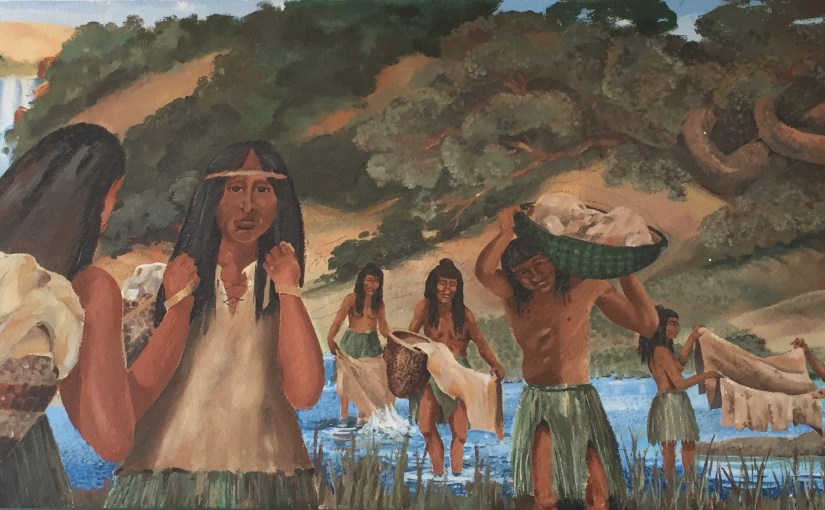
In the centuries before the friars built a mission here, in all those autumns of acorn gathering, how many native feet trod the ground beneath this house? When its foundations were laid seventy years ago, did the builders find potsherds or old Spanish coins? Did they find bones?
In the shadow of the yellow Victorian next door with its turrets and gingerbread trim, what inspired the architect to look further back in time to cloister arches and thick adobe walls?
The answers are lost in lathe and plaster. I like to think that the laughter and music and poems that bubble up in our home mean that it was constructed on happy ground, that in the five thousand years before the missionaries came, children played here. Boys walked up the hill from the river to hunt rabbit and squirrel; girls came to find berries.
Before the road in front of our house was paved, wagon wheels carved ruts in the earth. Now ten thousand cars a day drive by, and only small islands of forest and grassland remain where the city has grown.
Yet, still, acorns fall to the earth every autumn, and sometimes, sometimes a hawk circles overhead.
(Images of Ohlone village life from murals at the Wash & Dry on the corner of Water St. and Branciforte Ave. in Santa Cruz.)
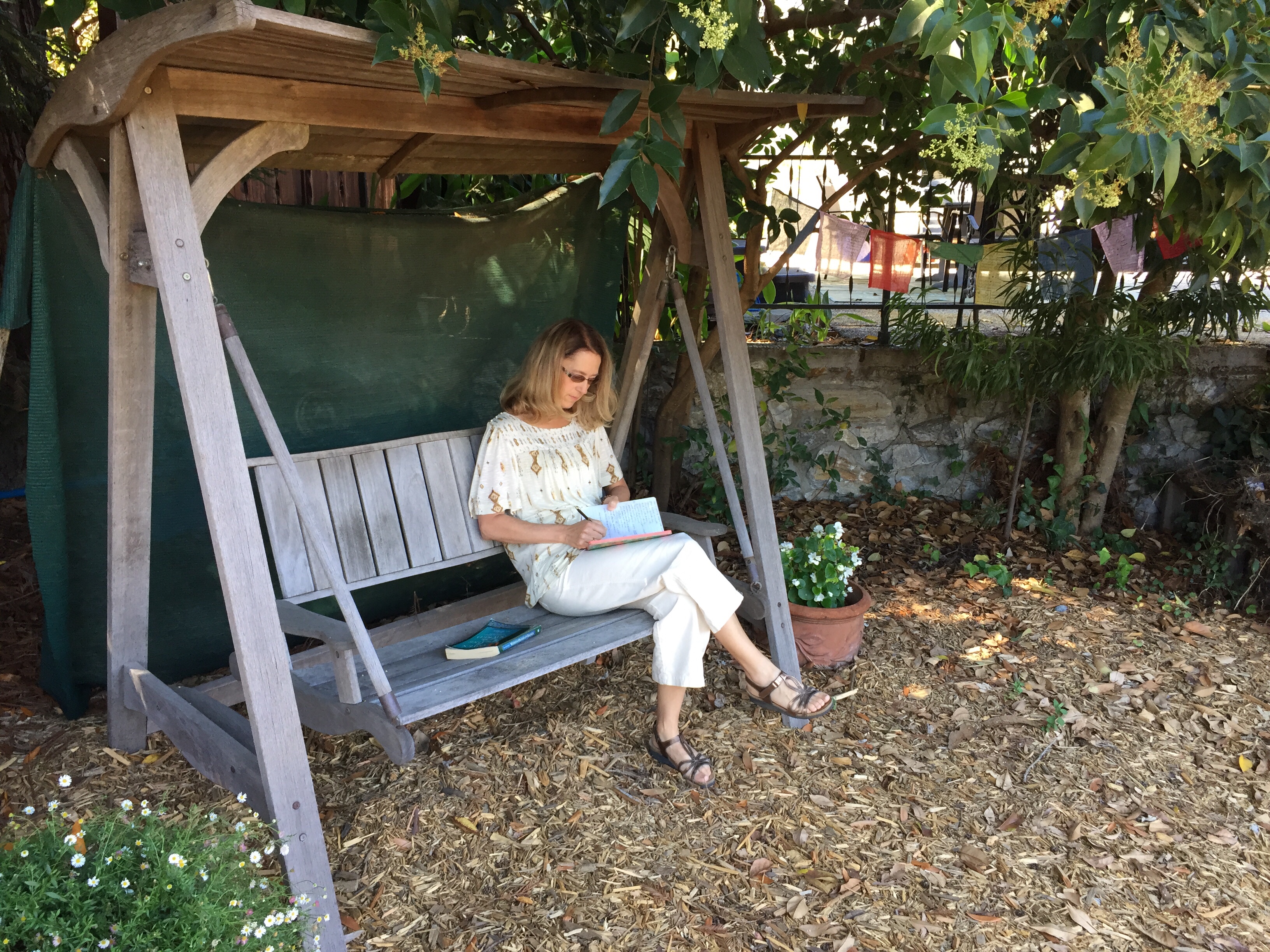
Our yet-to-be-born children would rock on this garden swing with their sweethearts one day, my ex-husband and I imagined when we bought it over twenty years ago. The jarrah wood was smooth then, polished a deep and lustrous brown. We bought a can of special oil too on the salesman’s recommendation, fully intending to recoat the swing at least once a year to protect the Australian hardwood, but that oil, like my husband and the dream of children we might have had, is long gone.
Instead the seasons in their turn have done the scouring and burnishing. For the last five years, in the garden I share with a new love, the swing has sheltered under the boughs of a redwood, its base moldering into the rich soil. Needles and cones and industrious spiders have joined the work of sun, wind, and rain to turn the wood rough and gray.
In the spring I brush away the cobwebs and duff and sit down on the old swing. My back nestles against a curve in its back, human spine, muscles, and sinew aligning with wood slats as if we were designed for one another. In the heat of the day the scent of feathery redwood branches mingles with childhood memories of camping in the mountains, and I push my foot against the cushion of forest floor in this little corner of my city garden to set the swing in motion. The rasp of wood in metal rings and bolts echoes the creak of my own joints. Someday I will accept my gray hair and wrinkles as graciously as I do this weather-roughened wood. Someday I will ripen into glory. But for now I glide back and forth with the whispers of those young lovers I dreamed of long ago. For now I am at ease in a moment of sun-softened stillness.
The first day in Zion our Road Scholar group walked on the canyon floor along the Virgin River, and I craned my neck to look up at a landscape unlike any I’d ever seen. Eons ago the sand dunes that covered this plateau petrified, and now the red rock walls towering above us offered a sense of the river’s long and languorous lovemaking with Navajo sandstone.
Early the next morning half our group began the hike up to Observation Point, knowing we would climb 2100 feet over the next four miles. The sun had yet to clear the eastern rim, so we walked in shade, bundled in warm clothes, just the twelve of us as opposed to the hundreds we’d encountered the day before. The trail was mostly wide and even as it switch-backed up the canyon wall and offered sweeping views down to Weeping Rock where we’d begun and across the canyon to the western wall. I fell into a slow and steady pace.
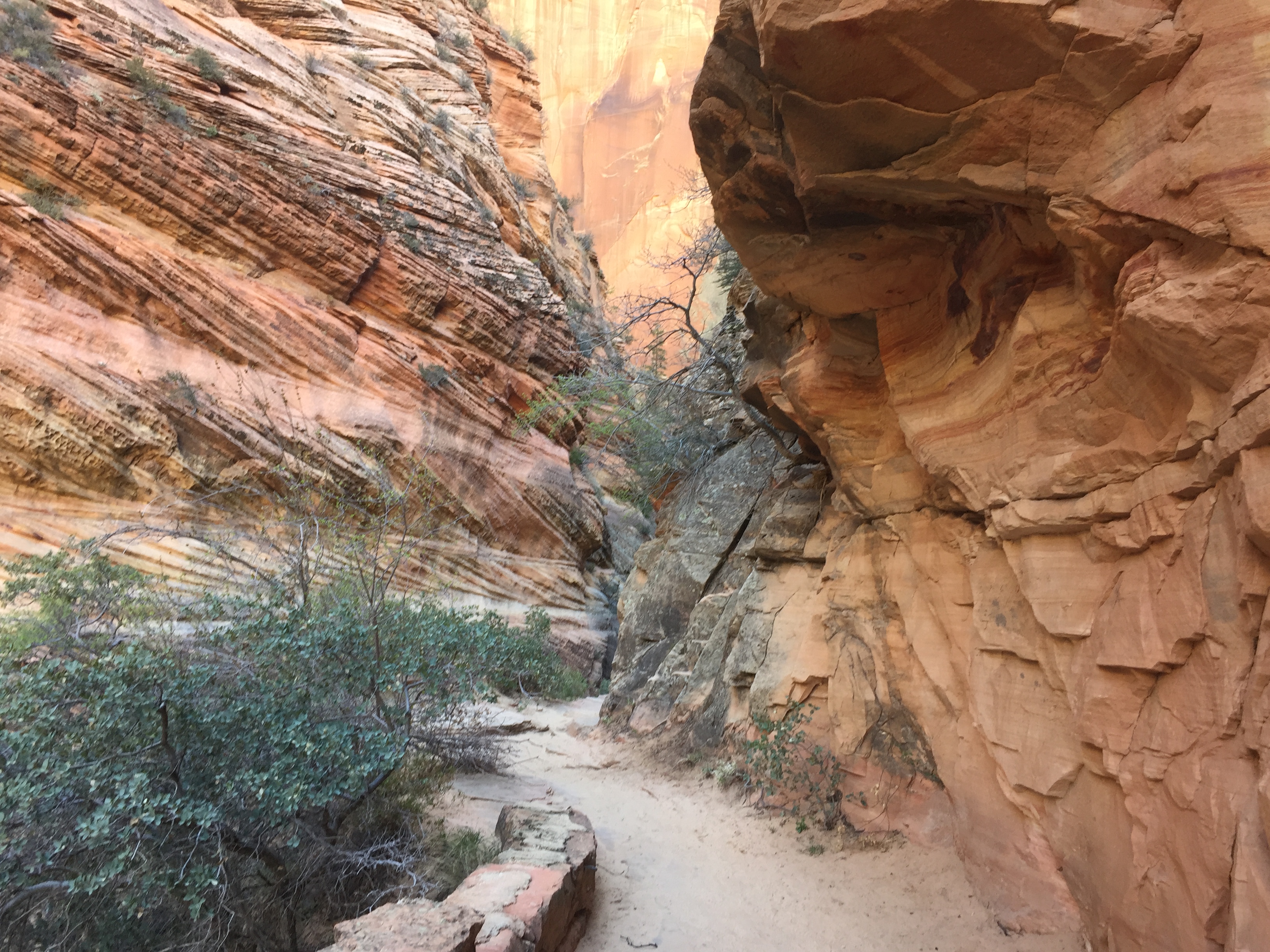
Perhaps an hour into the hike, the trail turned down a gorge called Echo Canyon into a scene so surprising and lovely that it stopped me in my tracks. Instead of being on the edge of a canyon wall I was suddenly inside, folded into the curves and undulations of stone, which were touched in this moment by the sun’s first tender kisses on red rock and secret pools.
It took nearly three more hours to reach Observation Point. As the group spread out, I often walked alone, up, up, up, taking breaks to peel off layers, drink water, and look at the desert world around me – slickrock paintbrush growing improbably out of a crack in the rock and striations in the curved canyon wall that I paused to study as I would a work of art in a museum. At one point I heard rumbling nearby and with the instincts of a city girl whirled around looking for a truck almost in the same instant that I realized how ridiculous that was. Instead, somewhere close but out of sight, rocks were crashing down the hillside. This is unstable country, I remembered our geologist guide saying. Was I about to be buried in an avalanche? The clatter faded. Or had Tom hiking somewhere ahead of me been hit by falling rock? I pressed on. Eventually the trail leveled off, and I came out to the point, where I found the rest of the group safe and sound. At 6500 feet we snapped photos and enjoyed stunning views down the canyon.
In the following days, as I hiked in Bryce, the Valley of Fire, and Red Rock Canyon, my thoughts kept returning – not to the height I’d attained at Observation Point, but to the quiet moment when the trail veered into Echo Canyon. What was it about that place? I guessed it was the intimacy of the lusciously curved red rock walls surrounding me. We’re used to being onthe earth, but in that passage of undulating stone I had the sense of being init. Unlike in a tunnel or cave, though, I was immersed instead of enclosed, in the light instead of in darkness. Maybe this glimpse of geologic time, a peek at eternity, hints at what the cave of the heart looks like.
On the day of the student walkout to protest gun violence, I was scheduled to staff the reference desk at ten a.m., a responsibility I could not reasonably forego. Early in the morning, I huddled with other staff. What could we do in the library? Lakshmi suggested we use our new intercom system to ask for a moment of silence. This might sound oxymoronic in a library, but at ten in the morning the Foothill College library is bustling with students checking out books, asking questions at the reference desk, and chatting with each other. Nevertheless, we agreed to try it.
And so, as hundreds of students, faculty, and staff streamed out of their classrooms and offices and headed to Cesar Chavez Plaza, I heard my own trembling voice echo through the library, “In memory of those who died in the shooting at Marjory Stoneman Douglas High School one month ago, please join the library staff in standing for a moment of silence.” The names of the seventeen victims stood on a list at the reference desk, remembered now by strangers here on the other side of the country from where they fell. I looked around. Some students went on about their business, but many others took a break from their books, devices, friends, and together we all stood without speaking or doing. I let two minutes pass before I switched the intercom on again, thanked everyone, and reminded them of the gathering in the plaza.
Over and done, but outside was a different story. Not two minutes, but seventeen. One minute for each life lost on February 14th. A minute is nothing compared to a life, and yet, it is something. Those holding silence were not monks or hermits, but young people bursting with energy, community college students juggling classes with jobs and families; they were professors accustomed to lecturing, for whom every minute of class time is precious, needed for the knowledge they want to impart and the experiences they want to create for their students. Friends who were there later told me that a sociology professor tolled the minutes with a Tibetan singing bowl, and each minute more people streamed into the plaza. Wind blustered, footsteps fell on pavement, bodies shuffled, but no one spoke as the bell resounded across the crowd.
This had been happening since seven a.m. when the walkouts started on the east coast, a wave of silence sweeping across the entire country. Honor and protest and hope are the gifts of those seventeen minutes, multiplied ten thousand times. May the silence bear fruit.
The first cookies I baked when I moved to The Netherlands came out of the oven flat, not just in shape, but in taste. Part of the problem, I discovered, was the flour, which is processed differently than in the States in a way that reduces the amount of gluten, and part of the problem was the butter. At home I took it for granted that our default butter is salted. Back in the eighties and nineties an American baker had to go out of her way to find what we call sweet butter, but in Holland the default butter is unsalted. It took several tries before I realized that all my recipes assumed the dash of salt from the butter in addition to the teaspoon explicitly stirred into the cookie dough, and I learned to seek out gezouten boter in a larger store than the corner grocery. And what about the flour? For special-occasion desserts it was worth driving to The Hague (home of the country’s embassies and hence a city that caters to foreigners), to the import shop I’d heard about through the American grapevine, where I spent way too many guilders for a pound of Gold Medal flour from home.
Pumpkins and turkeys were also absent from Dutch grocery stores, but Americans abroad are resourceful when it comes to our holidays. Each fall a few members of the American Women’s Club of The Hague drove across the border to a farm in Belgium that grew pumpkins and returned with a carload to resell as a fundraiser for the club. I often wondered what my neighbors in the little village of Waddinxveen thought about the jack-o-lantern gleaming from my window on October 31st.
Waddinxveen, small as it was, boasted a poultry shop, and my first November there I timidly inquired about procuring a kalkoen. The poulier’s face lit up, and it became clear he’d recognized my American accent. “It’s for your harvest celebration, isn’t it? I’ve heard of this!” He didn’t carry turkeys, but could special order one for me in time for the holiday. As he scribbled my information on an order pad, he asked what I’d be serving with it. “Aardappelen en …” Hmm, my Dutch vocabulary did not yet include words like stuffing and cranberries. Over the next years, he came to recognize me. “Ah, mevrouw Thomas, here for your oogst kalkoen, eh?”
I began my married life in Holland, and those years were my first attempts at cooking a Thanksgiving dinner myself. At first, it was just my husband and me, but each year we found more American friends to celebrate our holiday with in a country where the fourth Thursday in November is an ordinary workday like any other. With our homesickness like salt in the dough, friends became family around a table, a turkey, and blessing: a little island of home in the Dutch sea.




 In the centuries before the friars built a mission here, in all those autumns of acorn gathering, how many native feet trod the ground beneath this house? When its foundations were laid seventy years ago, did the builders find potsherds or old Spanish coins? Did they find bones?





 The Kingdom of Enough