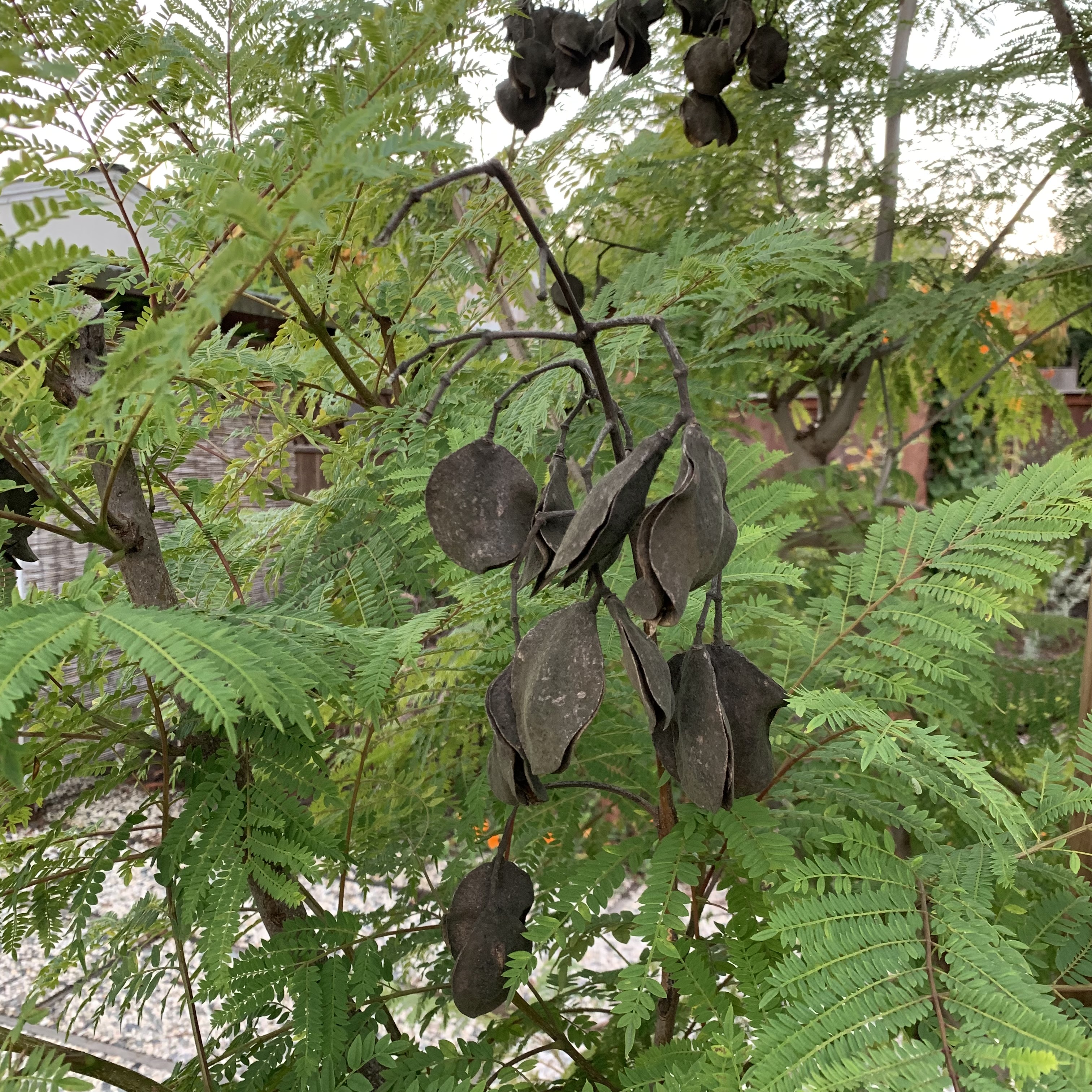
In April seed pods the size of black plums dangled from the bare branches of the jacaranda we had just planted in the heart of our garden. Would they drop eventually, we wondered? These dark ornaments were … well, ugly to our eyes. We worried too that — even though we’d purposely chosen a sapling with multiple trunks to create the effect of a copse instead of a lone tree – it might split. But what could we do now? Just trust in the nurseryman’s confidence in a tree’s capacity to heal itself and twice a week nurse it with buckets full of water, as precious in this drought as wine.
All spring we watched like new parents as lengthening days untied the knots of green nubs that formed on the jacaranda’s branches and unfurled feathery fronds. The seed pods hung there still, dusty black spades amidst the green froth. Would they ever drop? Should I prune them? But I don’t want to weed, rake, and trim nature right out of the garden. Sometimes when we try to beautify a landscape, we expunge wild processes we don’t understand. If I cut off the seed pods, would I cut off some vital service to the tree? A dozen websites and gardening books ignored my question but cautioned me not to expect blooms this first year. What cause for rejoicing then, like a baby’s first steps, when I noticed tiny buds in June. As if the jacaranda knew the myth of flowers blossoming on a magical fern deep in the Polish forest, a purple cloud bloomed to crown our garden. Yet even this halo could not hide the devil’s paws clutching last year’s dead limbs. Would they ever drop?
It is November now. With carapaces hard as glass, the pods hang there still, but I notice they have opened – just barely opened like a rotten oyster loathe to let go its pearls. The tree-given desire for life even in such tiny pips as a jacaranda’s seeds is enough to pry open the possessive lover’s door. The pods may never drop, but it seems the seeds have found their way to earth and (we may hope) rebirth.
If you realize you have enough, you are truly rich.
Tao te Ching
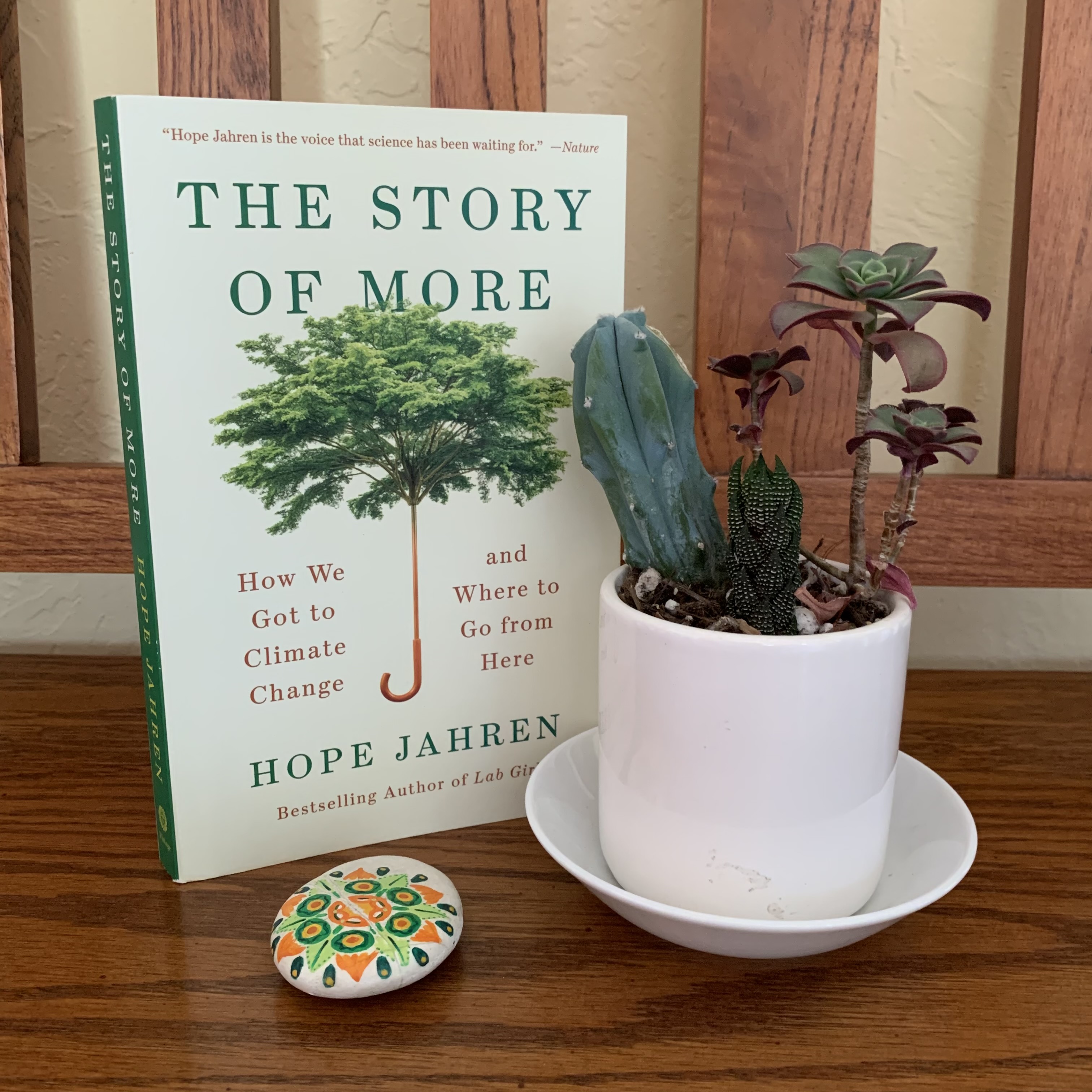
Of all the places I might go on my spring break as pandemic restrictions began to lift earlier this year, I chose Joshua Tree National Park. I craved the austere beauty of the desert in a way I couldn’t explain, but when I arrived in that wide-open wild landscape of dry sand and iconic rock formations, I realized that the book I was reading, The Story of More: How We Got to Climate Change and Where to Go from Here, must have sent me to the desert to look for role models of how to use less.
Who would have guessed that a science book would turn out to be the perfect reading for Lent? A spiritual text is a more obvious choice, Abandonment to Divine Providence say, or Prayer in the Cave of the Heart, but The Story of More by Hope Jahren had been waiting on my to-be-read pile for months. I loved her funny, poignant memoir Lab Girl and was curious what a smart botanist with a good sense of humor would have to say about climate change.
For a book loaded with statistics, The Story of More is surprisingly easy to read, partly thanks to Jahren’s casual, engaging style, partly to how relevant and vivid her statistics are. Instead of stating coal and oil use in tons and gallons, for example, she paints a picture: “Since 1969, the nations of the globe have burned enough coal to fill a grave the size of Texas and a volume of oil large enough to fill Lake Pontchartrain three times over.” Or she simply puts things in perspective: “waste of edible food has increased such that it now equals the amount of food needed to adequately feed all of the undernourished people on Earth.” Statistics like these break by heart.
So maybe I should have said that her book is readable instead of easy to read because in fact, reading it was hard, hard in all kinds of ways – painful to acknowledge the species that have gone extinct, frightening to consider devastating heat waves and crop failures, uncomfortable above all, to recognize our greed and waste and that we might need to change. When I say our and we, by the way, I mean those of us who live in the 36 countries of the OECD (including North America, Europe, Israel, Australia, New Zealand, and Japan). We’re the ones using the most energy and throwing food away.
Step by step Jahren takes us through population growth, the ways we grow (and waste) food, and how we make and use energy – not to make us feel guilty, but to explain how we got to climate change. She writes clearly, and even if the book is disturbing to read, it’s easy to understand. Ultimately, it’s hopeful because Jahren has ideas, just as her subtitle promises, for where to go from here. She sums them up in a simple motto: use less, share more. That motto is what made this book the perfect read for a season of fasting and almsgiving and maybe subconsciously what sent me to Joshua Tree looking for inspiration.
There, where the Mojave meets the Colorado Desert, plants and animals have evolved to survive in hot sun with little water. In contrast, as a human being I needed to slather on sunscreen, wear a shade hat, and drink at least a gallon of water a day. So how do desert flora and fauna do it? The Joshua tree, according to Blue Planet Biomes, turns its spiky leaves upwards to catch any moisture in the air and stores the water in its fibrous limbs and trunk; it also has an extra root system for storing surplus water. Human beings don’t have eons to evolve our physiology to that degree, but maybe our ingenuity can save us.
Illustration by Ann Thomas
Consider the tobacco moth caterpillar that naturalist Bernd Heinrich describes in his essay “Reading Tree Leaves.” In the Mojave this caterpillar grabs tight with its rear legs to the stem that attaches a jimsonweed leaf to the plant’s stalk, reaches its forelegs out to the tip of the leaf, and nibbles away at the edge while using the remainder of the leaf for shade, its own little green umbrella.
Climate change can feel so overwhelming that it’s paralyzing. At the end of her book Jahren suggests that the reader choose just one issue to focus on, one that tugs at your heart or that you worry about when you can’t sleep at three in the morning. Maybe it’s world hunger or ocean pollution, national parks or green energy. Pick an issue that matters enough to you that you’re willing to make a sacrifice for it and start by learning more about it. That’s exactly what I plan to do in future blog posts.
Which environmental issue is calling to you for action? Please reply in the comments!
Ann Thomas is a freeelance writer and illustrator living in Portland, Oregon.
I found Lauren Elkin’s book Flaneuse in the travel writing section of Bookshop Santa Cruz, but it is pleasantly hard to categorize: part memoir (a young woman leaves suburbia for the big city and eventually a life abroad), part musing on culture and feminism, part travelog. As any francophone could tell from the title, the focus is on walking. I don’t alas speak French, so I needed Lauren Elkin’s translation of flaneur: one who wanders aimlessly. She concentrates on the woman walker, the flaneuse, whom she defines specifically as “a determined resourceful woman keenly attuned to the creative potential of the city and the liberating possibilities of a good walk.”
Elkin herself fits this definition, and so do the women she writes about in her homage to the cities of New York, Paris, London, and Venice, to seeing them on foot, as a woman. (She writes about Tokyo too, but her relationship with that city seems as fraught and unfortunate as her relationship with the man she followed there.) Because my bent is towards literature, I especially enjoyed the chapters about Virginia Woolf in London and George Sand in Paris in which Elkin skillfully blends their relationship to those cities with her own, mixing literary reflections with travelog and memoir.
That doesn’t mean, however, that I didn’t also appreciate her forays into art, history, and politics. Reading about revolution and the history of the protest march in Paris, I found an explanation for the impulse that pulled me into the streets of Santa Cruz on January 21, 2017 even though I wasn’t sure what difference the Women’s March would make. “Marching is an instinctive response to feeling wronged, or desperate, or compelled to make a statement,” Elkin writes. I felt all three of those things after the 2016 election. “It makes us feel stronger to be part of a group,” she continues. “It feels good. Marching is a political act, but it’s a social one as well. We … feel we belong to something bigger than us.” I marched that day with my mother and my sister, friends, neighbors, and strangers, while my best friend joined over 470,000 people in Washington, D.C. and millions marched around the world. It did feel good, but Elkin recognizes the risk too. She describes participating in a march in Paris that splinters when the police block the street. She inadvertently follows a group of anarchists and ends up as part of a mob. “I felt uneasy. It was too easy to be led who knows where, by who knows whom, to do who knows what.” Her accidental experience stands in sharp contrast the mob that overran the Capitol on Wednesday. The insurrectionists might think that Trump led them there to stop the certification of an election he falsely claimed was stolen, but I can’t help thinking how satisfying the sight of that rampage on the house of the American people must have been to anarchists everywhere.
My motto is solvitur ambulando, it can be solved by walking. Like Martha Gelhorn I find flânerie “as necessary as solitude: that is how the compost keeps growing in the mind.” But I’m not a city person. Although I’ve meandered happily in Paris, London, Istanbul, and New York, in truth the city quickly becomes overstimulating for me, oppressive even and exhausting. I have to retreat to a hotel room to recover or better yet to the country where I can walk a quiet lane or a path in the woods. Yet Elkin managed to sweep me up in the romance of flaneuse-ing around a city, and maybe precisely because the pandemic has put it out of reach, I now fantasize about flying to Paris with a pair of comfortable shoes and my notebook. Paris is where Elkin has made her home and the city she writes most about, a city whose streets I too have wandered many times over the last forty years, with friends and sweethearts, with my sisters and by myself, so I’m seduced equally by Elkin’s evocative writing and my own memories.
“There is a sense of the city you can’t plot on a map or a phone,” she says, and I long for that elusive sense, to roam aimlessly, to trust where my feet and chance might take me. What would I observe this time, “keenly attuned to the creative potential of the city,” as I strolled through the Marais or the Luxembourg Gardens? When I got tired and overstimulated, what would I write as I sat in a café people-watching and drinking café crème?
Yet here comes my inner realist to rein in the romantic. It’s January, the weather is miserable, maybe I’ll wait till summer. For now, I’ll sit with a notebook here at home, enjoying the view out my window of the winter garden and armchair traveling with an accomplished writer who knows how to share “the liberating possibilities of a good walk.”