Saying Grace

A life lived gratefully transforms every moment

by turning a thank you into action.

— Joe Primo

hands picking coffee beans

Sometimes, early in the morning when I’m making mochas for Tom and me, I wonder how much longer I’ll be able to scoop coffee beans from Brazil into my countertop grinder or cocoa from Cameroon into my frothing oat milk. As temperatures rise, will the high plateaus and island jungles where coffee plants thrive become too hot, too dry? How much longer will the world’s infrastructure sustain shipping these commodities across oceans and continents, and does it even make economic sense to do so? It’s not hard to imagine a time when my seemingly small daily luxury becomes an unaffordable delicacy.

Whether or not I can continue drinking mochas is obviously the least of our worries when it comes to climate change. Having breathed the smoke of wildfires and wiped the ashes from my car windows, I know this. But wondering about the future of coffee and cacao, these beans that bring delight to people all over the world, reminds me how precarious life as we know it is. It reminds me to take pleasure in the work of my hands while I can, brewing, frothing, blending, to appreciate the faraway farmers and their trees, and to savor each sip. In the quiet of early morning, these questions remind me to whisper, “Thank you for these precious ingredients. Thank you for the miracle of this moment.”

Although I was brought up to say grace before dinner, “Bless us, O Lord, and these Thy gifts,” I lost the habit when I went away to college, and I’m trying to get it back now, to say a silent thank you before a meal or even repeat aloud that old Catholic blessing from my childhood. Occasional nudges help. At potluck lunches with my writing group my friend who was a preschool teacher leads us in a song she used to teach her young students, and at family dinners my mom reminds us to bow our heads and offer thanks. A couple I know holds hands for a moment of silence before picking up their forks, a moment of private connection and blessing. 

Too often, though, I forget. Even now, when gratitude has become a highly recommended mindfulness practice, I too often take it all for granted – the farmers, truck drivers, and cooks responsible for getting the food I eat from the earth to my plate and (not to get carried away, but let’s be blunt) the plants and animals that died so I might go on living. It’s an extraordinary transaction when you think about it. 
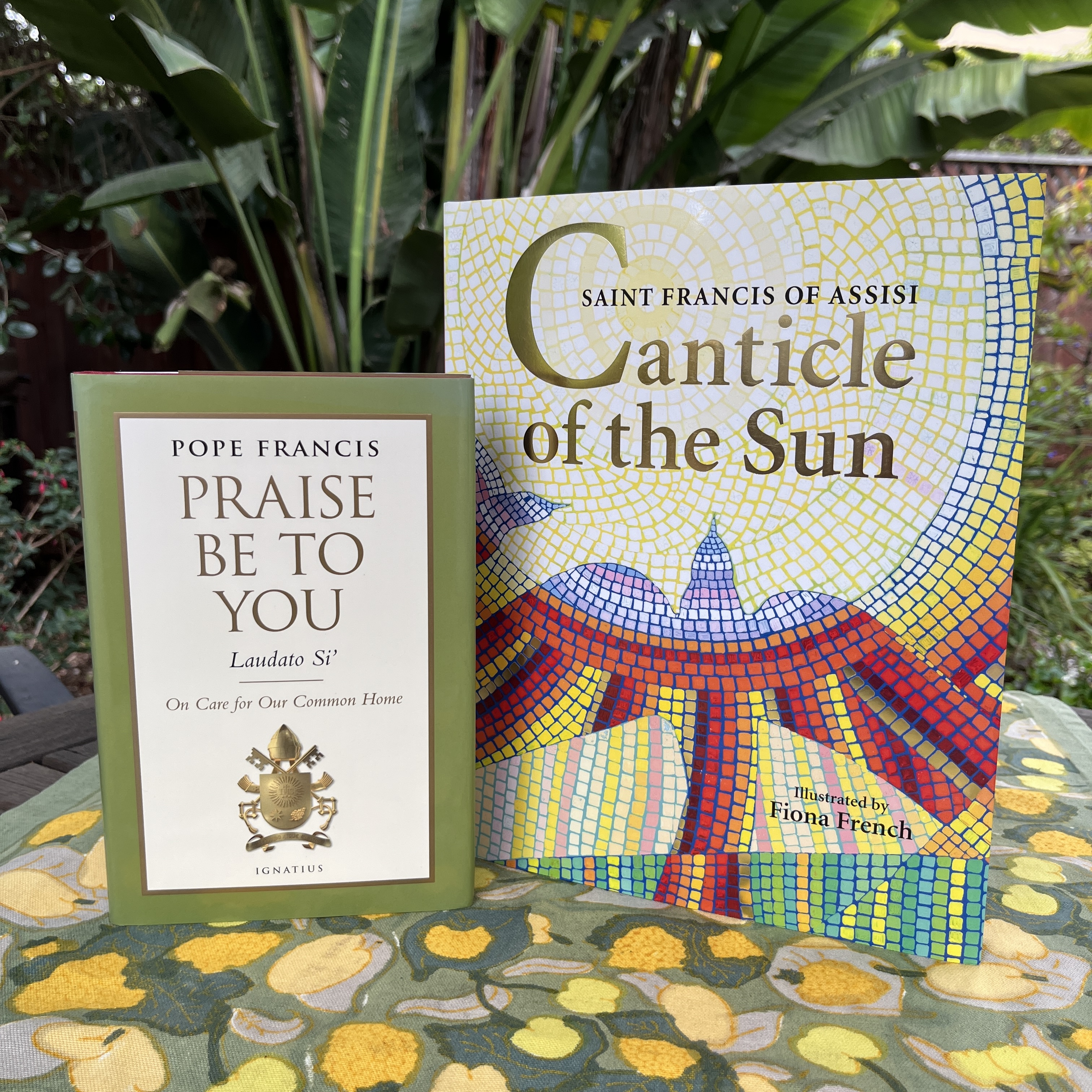
What can I do about climate change beyond what I’m already trying with my solar panels and plug-in hybrid car? It’s too much to hope that my personal gratitude could inspire global stewardship, which is what we need, but Pope Francis’ title for his 2015 encyclical on the environment, Laudato Si, inspires me. Echoing Saint Francis of Assisi’s “Canticle of the Sun,” laudato si means “praise be to you” in medieval Italian, and the encyclical opens with the saint’s reminder “that our common home is like a sister with whom we share our life and a beautiful mother who opens her arms to embrace us.” Even if you don’t believe in God, acknowledging Mother Earth with a moment of appreciation before consuming her fruits seems only polite.

Will gratitude save the world? Not by itself, nor does it absolve me of responsibility, but I like to think that the butterfly effect gives wings to any personal energy of appreciation. Maybe thank you can turn into action: signing a petition, planting a tree, using less and sharing more. For me, saying grace is one way to resist the apathy and despair that big problems paralyze me with, and one act of resistance can lead to another, awareness the beginning of caring for our common home.

Given the mocha in my cup and the food on my table, it’s the least I can do.

Page from picture book Canticle of the Sun with the words Praise to thee, my Lord, for our sister Mother  Earth who sustains and directs us ...

Photograph of hands harvesting coffee beans courtesy of Saddymonster via Wikimedia Commons.

Use Less, Share More

If you realize you have enough, you are truly rich.

Tao te Ching

Collage of three desert photos: the author sitting on a rock, a Joshua tree, and a chollo cactus.

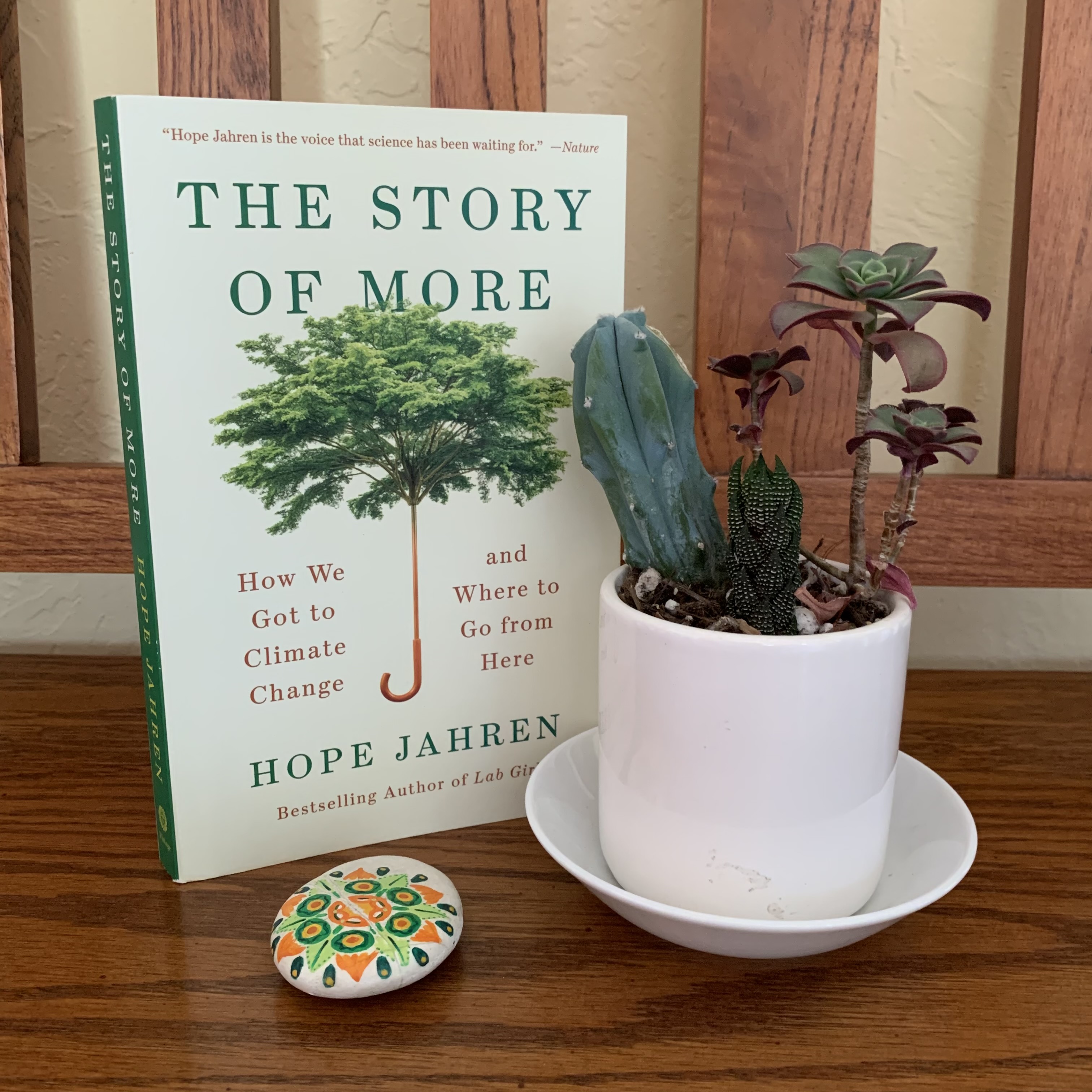
Of all the places I might go on my spring break as pandemic restrictions began to lift earlier this year, I chose Joshua Tree National Park. I craved the austere beauty of the desert in a way I couldn’t explain, but when I arrived in that wide-open wild landscape of dry sand and iconic rock formations, I realized that the book I was reading, The Story of More: How We Got to Climate Change and Where to Go from Here, must have sent me to the desert to look for role models of how to use less.

Who would have guessed that a science book would turn out to be the perfect reading for Lent? A spiritual text is a more obvious choice, Abandonment to Divine Providence say, or Prayer in the Cave of the Heart, but The Story of More by Hope Jahren had been waiting on my to-be-read pile for months. I loved her funny, poignant memoir Lab Girl and was curious what a smart botanist with a good sense of humor would have to say about climate change.

Photo of the book The Story of More next to a cactus

For a book loaded with statistics, The Story of More is surprisingly easy to read, partly thanks to Jahren’s casual, engaging style, partly to how relevant and vivid her statistics are. Instead of stating coal and oil use in tons and gallons, for example, she paints a picture: “Since 1969, the nations of the globe have burned enough coal to fill a grave the size of Texas and a volume of oil large enough to fill Lake Pontchartrain three times over.” Or she simply puts things in perspective: “waste of edible food has increased such that it now equals the amount of food needed to adequately feed all of the undernourished people on Earth.” Statistics like these break by heart.

So maybe I should have said that her book is readable instead of easy to read because in fact, reading it was hard, hard in all kinds of ways – painful to acknowledge the species that have gone extinct, frightening to consider devastating heat waves and crop failures, uncomfortable above all, to recognize our greed and waste and that we might need to change. When I say our and we, by the way, I mean those of us who live in the 36 countries of the OECD (including North America, Europe, Israel, Australia, New Zealand, and Japan). We’re the ones using the most energy and throwing food away.

Step by step Jahren takes us through population growth, the ways we grow (and waste) food, and how we make and use energy – not to make us feel guilty, but to explain how we got to climate change. She writes clearly, and even if the book is disturbing to read, it’s easy to understand. Ultimately, it’s hopeful because Jahren has ideas, just as her subtitle promises, for where to go from here. She sums them up in a simple motto: use less, share more. That motto is what made this book the perfect read for a season of fasting and almsgiving and maybe subconsciously what sent me to Joshua Tree looking for inspiration.

There, where the Mojave meets the Colorado Desert, plants and animals have evolved to survive in hot sun with little water. In contrast, as a human being I needed to slather on sunscreen, wear a shade hat, and drink at least a gallon of water a day. So how do desert flora and fauna do it? The Joshua tree, according to Blue Planet Biomes, turns its spiky leaves upwards to catch any moisture in the air and stores the water in its fibrous limbs and trunk; it also has an extra root system for storing surplus water. Human beings don’t have eons to evolve our physiology to that degree, but maybe our ingenuity can save us.

Illustration by Ann Thomas

Consider the tobacco moth caterpillar that naturalist Bernd Heinrich describes in his essay “Reading Tree Leaves.” In the Mojave this caterpillar grabs tight with its rear legs to the stem that attaches a jimsonweed leaf to the plant’s stalk, reaches its forelegs out to the tip of the leaf, and nibbles away at the edge while using the remainder of the leaf for shade, its own little green umbrella.

Climate change can feel so overwhelming that it’s paralyzing. At the end of her book Jahren suggests that the reader choose just one issue to focus on, one that tugs at your heart or that you worry about when you can’t sleep at three in the morning. Maybe it’s world hunger or ocean pollution, national parks or green energy. Pick an issue that matters enough to you that you’re willing to make a sacrifice for it and start by learning more about it. That’s exactly what I plan to do in future blog posts.

Which environmental issue is calling to you for action? Please reply in the comments!


Ann Thomas is a freeelance writer and illustrator living in Portland, Oregon.

What Cannot Be Defied

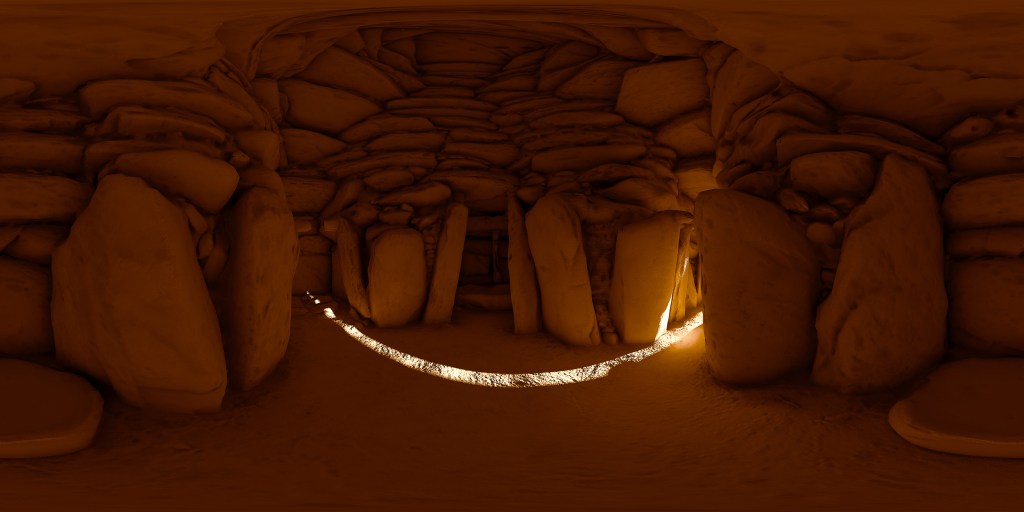
sunlight pouring into the inner chamber of Newgrange

Apples ripened and acorns fell early,

confusing madcap squirrels.

Girls wore sundresses in November,

and the pedicurist polished

toes to peep out of sandals.

Where were the umbrellas and wool sweaters?

Our customary summer drought

lingered past its welcome;

even the rosemary and echevaria thirsted.

But beyond our fevered planet’s ripped cocoon,

the stars still proceed in their stately course.

We may defy gravity,

but the law itself remains unbroken.

Our earth continues to orbit the sun

at the same tilt,

and the days grow shorter.

At dawn on the winter solstice

sunlight will pour down the ancient stone passage

just as it did five thousand years ago.

Oh, praise the light that is beyond our reach!

What Shape Waits in the Seed

When humans begin to play

in the workshop of the Mother,

we cheer at the fireworks

and admire our reflection

in the miracles we have wrought.

She welcomes her co-creators,

but how proud we are

to loosen the strings

and toddle away.

It’s easy then

to mistake a warning shot

for the starting gun

and take off in a carbon-fueled race to the stars.

Few notice when winter snows come late

and monarchs lose their way.

Hungry engines keep boring,

while tinkering fingers slide up the double helix.


monarch butterfly

What shape waits then in the milkweed seed,

and who will hear the cries

when caterpillars stop turning into butterflies?


Title from “What to Remember When Waking” by David Whyte

Written upon learning that monarch butterflies will likely be extinct in twenty years.

Image courtesy of Kenneth Dwain Harrelson


A Temple in Time

On the winter solstice a few days before I turned fifty, I rose before dawn, smudged with burning sage, and drove to a park overlooking the ocean where I could walk in silence and plan a ritual for my upcoming birthday. Although I didn’t know it then, my musings that morning turned out to be the genesis for this blog.

The sickle of the old moon hung in the eastern sky, and frost glazed the fields. As the sun rose over the hills behind me, I knelt and touched my forehead to the earth “for all my relations.” Two days earlier I’d asked a friend who was turning seventy if she had any words of wisdom to share. “Know yourself and accept who you are,” she answered. Her advice was in my mind as I pulled the hood of my down jacket up over my head and walked towards the ocean.

From the cliff I watched sandpipers on the beach below race away from an oncoming wave, then chase it as it receded, and they reminded me exactly of the frenetic way that I plunge into activities, then rush through them so I can hurtle into the next item on my to-do list. I work fulltime, I commute, and I never have time for everything I want to do: read novels, garden, knit a sweater, hike, cook dinner for friends, listen to my beloved play love songs on the ukulele … Sometimes I also worry about money and being alone in my old age and whether I’m a good enough person, but mostly I’m tormented by a lack of time. Who was I? A person afraid of not having enough.

Yet here I was looking out at the great expanse of the Pacific Ocean in a wide open morning lush with stillness and winter sunlight. The night before, my writing sisters had sent me off into the silence of this sacred world with laying on of hands and blessings, and now the whole day lay before me. How could I really feel that I didn’t have enough?

Then an NPR story I’d recently heard on my way to work suddenly came to mind: about how climate change is making the world’s oceans so acidic that many sea creatures can no longer survive there. I gazed out at the Pacific. From up here it looked peaceful and pure. Further out beyond the shelter of Monterey Bay gray whales were hurrying south to the lagoons of Baja where they would mate and give birth in a few months. This blue ocean that stretched further than my eye could see had always seemed to me like the great mother, the epitome of bounty, yet in her unseen depths the creatures that called her home might be dying.

We actually don’t have enough, I thought. Not enough clean air to keep our climate stable, not enough oil, food, water …

But on the heels of this thought followed a crucial phrase: we don’t have enough if we keep using it as we have been. If we as a species somehow decided to start being good stewards, there would be enough. Maybe not a superabundance, but enough. And what was true of the human population on the planet was true for me in my personal life too. Yes, there are limits. My time in this body is finite, and I can only do so much, but if I recognize my limits and use my time, energy, and money wisely, I have enough, not so much that I can squander it, but enough for what is important.

Is that what this blog is all about? Triage and time management? When I told my sister about “The Kingdom of Enough,” she said, “So it’s about simplifying your life?” Well, yes, I imagine writing about the virtues of thrift and sustainable living, but I also envision more. Life is short, and we live in a crazy, consumer culture that is busy bombarding us with demands and desires, yet in the cave of every heart peace reigns. I want to explore how to touch that grace.

Later on that winter solstice morning, I climbed down to the beach and collected small gray stones polished smooth by the ocean, cradled them in my hand and hoped the years were polishing me in the same way. A little cove offered a meditation spot, and for a long time I sat alone with the sound of the surf and chirping birds. I felt like I was in a temple in time. Yes, constraints exist for me as an embodied creature, but in the life of the spirit there are no clauses or caveats. The soul has all eternity, and the power of love is infinite.